By Patrick Holford, founder of Food for the Brain. In this article, he discusses the importance of omega-3 fatty acids and B vitamins for optimal brain health.
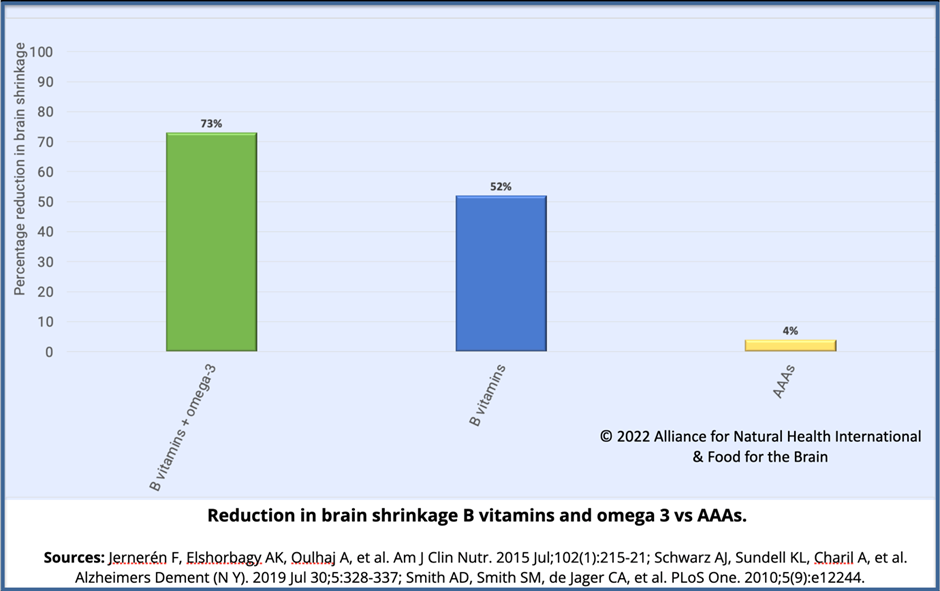
Research confirms that combining B vitamins with omega-3 fats can cut brain shrinking by 73% compared to placebo, offering real hope for Alzheimer’s prevention. Once considered too good to be true, the finding – first made at the University of Oxford – has now been independently confirmed by research groups in Holland, Sweden and China.
Headed by Professor David Smith, former Chair of Pharmacology and Deputy Head of the Division of Medical Sciences at Oxford University and director of the Oxford Project to Investigate Memory and Ageing (OPTIMA), the research found that giving older people with the first signs of cognitive impairment supplemental B vitamins (B6, B12 and folic acid) at higher levels than can be achieved through diet, together with sufficient omega-3 fats, produced 73% less brain shrinkage in a year compared to placebo. [1] This reduction brought brain shrinkage down to the level found in elderly people with no cognitive impairment. Cognitive decline was also significantly slowed in those with high omega-3 who were treated with B vitamins. [2] The trial was part-funded by Alzheimer’s Research UK. “The effect is greater than that of any drug treatment to date – with no adverse effects,” says Professor Smith. In contrast, recent trials of anti-amyloid drugs have reduced brain shrinkage by a non-significant 4%. [3]
Three other research groups have confirmed that the combined effect of omega-3 and B vitamins is greater than either nutrient on its own. A new meta-analysis of 14 studies, published in the British Journal of Nutrition, [4] found that people aged 60–70 who supplemented with a combination of B vitamins and omega-3 fats had less cognitive decline than those who did not. The research, which included a total of 4,913 people followed up over 6 months to 4 years, concluded that “increasing intake of both nutrients benefits cognition in older adults compared to placebo.”
You literally cannot build brain cells without both omega-3 fats and sufficient B vitamins. The analogy I use is that if you give a builder a hammer or a bag of nails, you don’t get a house. But if you give them both, they can build a house. The B vitamins drive a process called methylation, which assembles the critical brain-building fats that make up the membrane of neurons, through which all brain communication happens. Both are vital for building brain cells. Neither can work without the other.
Watch this one-minute film to see how you can build new brain cells at any age.
Realising that the combination of B vitamins and omega-3 fats is key, researchers in Holland, who had previously run a major trial called ‘B-PROOF’ that tested the effects of B vitamins on memory but found only very modest benefits, decided to reanalyse the results according to participants’ blood levels of omega-3 at the start of the trial. Sure enough, they found no benefit at all from the B vitamins in those with low omega-3 status, but a big improvement in cognition in those in the top third of omega-3 levels. [5]
Could this need for both explain why some trials testing omega-3 alone were not successful?
Oxford University researchers, led by Dr Frederik Jernerén, were given access to blood samples from a trial in Sweden called ‘OmegAD’. This trial had given Alzheimer’s patients a hefty dose of 2.3 grams (two large capsules) of omega-3 fish oils. The trial had apparently failed, showing no significant cognitive benefit. Could faulty methylation, caused by a lack of B vitamins, be the reason the omega-3 fish oils didn’t work?
The Oxford researchers measured homocysteine, a marker of poor B vitamin status, in the OmegAD samples, splitting participants into thirds from the lowest to the highest homocysteine level. Those given omega-3 who had the lowest homocysteine (i.e. those sufficient in B vitamins) showed a highly significant improvement in their clinical dementia rating, while those with high homocysteine (poor B vitamin status) had no benefit at all. [6] The group with sufficient vitamin B showed a reduction in their clinical dementia score three times greater than that reported in the recent Lecanemab anti-amyloid drug trial. [7] (See charts below.)

These findings highlight the importance of considering omega-3 alongside other aspects of nutritional health. For more information on the evidence for supplementation, EPA and DHA intake, and the different products available, read our omega-3 supplementation guide.
Meanwhile, another trial in China gave people with pre-dementia either the B vitamin folic acid, omega-3, or both, compared to placebo. Although B vitamin treatment and omega-3 treatment alone each slightly improved cognitive scores, the improvement was much greater in those given both nutrients together. [8]
With 170 million people over 65, Chinese authorities are taking dementia prevention extremely seriously. Professor Jin-Tai Yu, at Shanghai’s Institute of Neurology at Fudan University, carried out one of the most thorough reviews of all risk factors for Alzheimer’s to date. [9] “Lowering blood homocysteine levels, an established indicator of Alzheimer’s risk, with B vitamins is a most promising approach,” he concluded. He was also given access to the UK’s Biobank data of almost half a million people: “Our current research … shows that having higher blood levels of polyunsaturated fats, including omega-3, and supplementing with fish oils, is associated with less risk of dementia. [10] Moreover, recent studies suggest these two factors, homocysteine-lowering B vitamins and omega-3, may, in combination, be potentially more beneficial. They are easy to implement. This is worthy of further research.”
The UK Biobank data showed that something as simple as taking fish oils reduced dementia risk by 9%, equivalent to the risk reduction found from quitting smoking. [11]
US researchers at the National Institutes of Health have confirmed this, attributing almost a quarter (22%) of Alzheimer’s cases to a lack of B vitamins and raised homocysteine, and the same proportion (22%) to a lack of omega-3 and seafood intake. [12] This means that about one in three cases of Alzheimer’s could potentially be avoided simply by taking a daily high-dose B vitamin supplement and an omega-3 fish oil capsule, which could spare an estimated 70,000 people a year in the UK from developing dementia. Currently, about 600 people are diagnosed every single day. [13] And the benefit isn’t only for the future: a study of healthy 65-year-olds given omega-3 fish oils showed both improved memory and healthier brain tissue within six months. [14]
As an Alzheimer’s prevention charity, we target eight prevention steps in our online Cognitive Function Test™ and Dementia Risk Index questionnaire, including taking B vitamins and omega-3. These are two of the easiest to change, and the most evidence-based, prevention steps anyone can take.
Diet and lifestyle factors are estimated to account for up to half of the risk for Alzheimer’s, yet research funding worldwide continues to be weighted heavily towards drug development rather than prevention. “We’ve been applying to UK and EU agencies for several years to fund the obvious next trial, testing the effects of B vitamins and omega-3 combined, to see if they slow or prevent conversion from cognitive impairment to dementia, but without success so far,” says Professor Smith.
The UK Government has pledged to deliver a ‘Dementia Moonshot’, doubling dementia research funding to £160 million to ‘fast-track the development of new treatments’, while diet and lifestyle prevention research remains comparatively under-resourced. Much of current research funding continues to support drug development: an estimated $45 billion has been spent so far on amyloid drug trials and research [15] without producing a clinically meaningful treatment. Isn’t it time prevention was taken just as seriously?
We test thousands of people every month with our free online Cognitive Function Test™, assessing all risk factors through a 140-question questionnaire, including the need for B vitamins and omega-3. We also offer the Dementia Risk Index Functional Test (DRIfT®), a finger-prick blood test that measures five important biomarkers linked to brain health and dementia risk.
Right now, we know enough to cut the average person’s risk of developing Alzheimer’s by up to two thirds, and the number of people developing dementia by a third, if only there was the will to act on it.
Some influential reviews of dementia prevention evidence, including a widely cited Lancet Commission report, have not yet incorporated this specific research on B vitamins and homocysteine, despite the strength of the trial data. As the evidence continues to build, we’d like to see it reflected in the guidance millions of people rely on.
One current prevention study, called ‘AppleTree’, is under way at University College London. It focuses on reducing Alzheimer’s risk through a Mediterranean-style diet and lifestyle advice, including encouraging smokers to quit, a known risk factor for cognitive decline. Being a smoker increases dementia risk by 1.5 times, and quitting for at least three years reduces much of that risk. One in twelve people over 65 smokes. [16]
By comparison, almost half of all people over 65 have raised homocysteine, [17] which increases the risk of cognitive impairment by up to ten times, according to Chinese research published last year. [18] Lowering homocysteine with B vitamins, alongside sufficient omega-3, could substantially reduce that risk. Based on these comparative figures, targeting B vitamins and omega-3 could be up to twenty times more impactful for dementia prevention than quitting smoking alone, yet supplementation isn’t currently part of the AppleTree protocol.
What all of this research points to is a genuinely hopeful message:
Alzheimer’s is not simply something that happens to us. For most people, it is a largely preventable disease, and B vitamins and omega-3 are two of the simplest, most affordable, and most evidence-based places to start. Alongside the other prevention steps we assess through our free Cognitive Function Test™, they put real, practical power over your own brain health back in your hands, at any age.
This is the belief that drives everything we do at Food for the Brain: that with the right information, cognitive decline is not inevitable, and it is never too early, or too late, to start protecting your brain.
If you’d like to find out your own risk and what you can do about it, take our free Cognitive Function Test™, and you can order your at-home finger-prick DRIfT blood test.
And thank you for joining our community of Citizen Scientists, helping to advance dementia prevention research.
This article is for general information only and does not constitute medical advice. It should not be used to diagnose, treat or replace consultation with a qualified healthcare professional. If you have concerns about your memory, cognition or health, please speak to your GP before making changes to your diet or supplement routine.