New Alzheimer’s Drug Accelerates Rate of Brain Shrinkage by 20%
Don’t be fooled by the rhetoric promoting the new Alzheimer’s anti-amyloid drug. The results – increased brain shrinkage, a third getting brain bleeding or swelling and questionable clinically meaningful benefit – are not good.
However, reading this week’s headlines claiming a ‘turning point’ in the fight against Alzheimer’s you’d be mistaken in thinking something new has occurred since Eli Lilly’s press release regarding their new drug, donanemab, a month ago. What stimulated this week’s front pages was publication of the actual study in the Journal of the American Medical Association [1] giving more details of the results. This was reported positively in every major newspaper. Yet not one reported the fact that the drug treatment accelerated the rate of brain shrinkage by over 20% compared to placebo. This is clearly stated in the paper as “At 76 weeks, MRI [scans] showed a greater decrease in whole brain volume”.
This is consistent with a meta-analysis of all anti-amyloid treatments including donanemab, in the journal Neurology [2] earlier this year, which concluded that “Mild cognitively impaired participants treated with anti-amyloid drugs were projected to have a material regression toward brain volumes typical of Alzheimer dementia approximately 8 months earlier than if they were untreated.”
In stark contrast, treatment with homocysteine-lowering B vitamins, given to those with sufficient omega-3, ‘the rate of atrophy was significantly slowed by circa 70%’.[3] B vitamins and omega-3 are but two out of eight established prevention steps you can take yourself.
Alzheimer’s is characterised by brain shrinkage, and particularly in the central ‘hippocampus’ area of the brain. The new drug treatment was not associated with shrinkage of the hippocampus, just the whole brain. In fact, there was a very small reduction of about one per cent in shrinkage in this area of the brain compared to the placebo. In the B vitamin study there was an 80% reduction in shrinkage in the medial temporal lobe. While it is theoretically possible that, having selected people with lots of plaques, then targeting them with an aggressive drug, the brain may have shrunk as part of the process of amyloid destruction, this is not yet known and therefore this increased brain shrinkage is worrying
The other main measure of Alzheimer’s and dementia, made by a health professional, include interviewing the patient’s carer or partner – thus potentially subject to ‘hopeful’ bias – is the Clinical Dementia Rating (CDR).
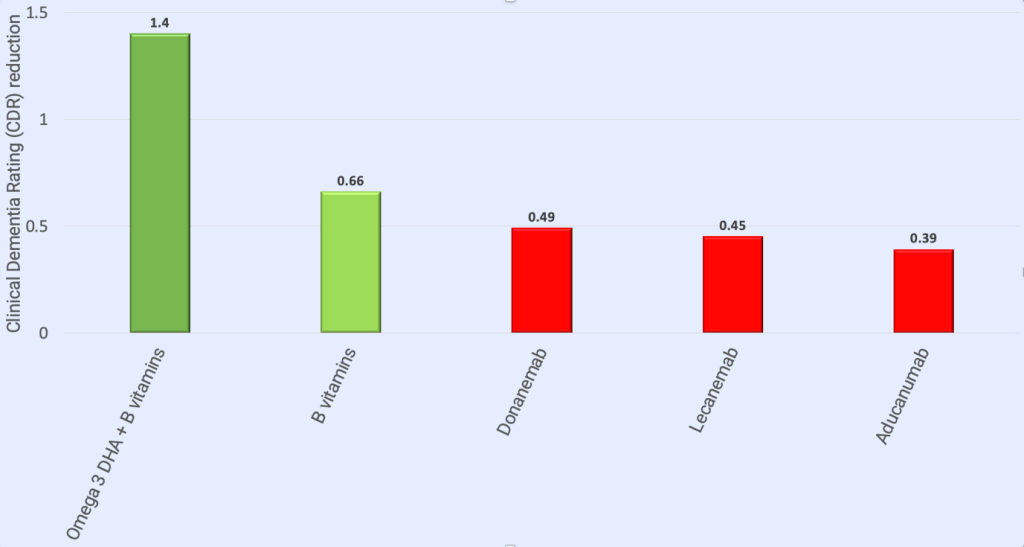
The new drug treatment results do show a statistically significant improvement, showing just over half a point (0.67) less worsening, compared to placebo, on the 18 point CDR scale. But is this small change meaningful? A study in the Lancet suggests that minimum changes of 0.98 in mild cognitive impairment and 1.63 in mild Alzheimer’s disease are meaningful. [4] This study was on those with early Alzheimer’s.
In contrast, a trial giving omega-3 fish oils to those with adequate B vitamin status, showed three times this beneficial clinical effect [5]. In another, giving homocysteine lowering B vitamins to those with adequate omega-3, almost two thirds of the trial participants ended the trial with an overall Clinical Dementia Rating of zero [6]. This means they were no longer diagnostically labelled as having cognitive impairment. In other words, not less worse, but actually better.
Serious adverse effects including deaths
More details in the recent donanemab paper were given on the adverse effects and trial deaths. ‘Treatment-emergent adverse events’ were reported by 759 of 853 participants (89%) receiving donanemab’ and ‘Either amyloid-related imaging abnormalities of edema/effusion [swelling] or microhaemorrhages [bleeding] occurred in 314 participants (37%) receiving donanemab’. Also, in the donanemab group, ‘3 participants with serious amyloid-related imaging abnormalities subsequently died.’ This means that more than a third had brain bleeding or swelling and 1 in 287 died. This compares to no adverse events in the B vitamin and omega-3 trials, or other prevention approaches. If any nutritional supplement had anything like these adverse effects it would be banned, not licenced.
According to the Financial Times, this new treatment will cost $26,000 a year (in addition to medical costs including numerous scans). In the UK this would be paid by the taxpayer. In contrast, taking homocysteine-lowering B vitamins, eating fish and/or having fish oil supplements would cost perhaps 20p or cents a day.
So, the question is would you rather take a treatment that markedly slows both whole brain and medial temporal lobe shrinkage than a treatment that is associated with a greater loss of brain volume, a high risk of adverse effects and costs.
The big push is now on to get approval of the UK’s NICE (National Institute for Health & Care Excellence) and the drug licensed in Europe. NICE have previously refused to consider the evidence for homocysteine-lowering B vitamins and omega-3, which is now overwhelmingly positive, when both these nutrients are combined.
That is why we, at Food for the Brain, aim to make sure as many people as possible know that the real ‘turning point’ for Alzheimer’s is prevention through diet, nutrition and lifestyle improvements, not expensive drugs with dangerous side-effects.
Please take the Cognitive Function Test yourself at foodforthebrain.org, and encourage all you know to do the same. We appreciate your support by becoming a Friend at foodforthebrain.org/friend.