

15 Risk Factors for Young-Onset Dementia Identified in Major UK Biobank Study

What the findings tell us about modifiable dementia risk and the 8 Domains of Brain Health
A major study using data from the UK Biobank has identified 15 factors associated with the risk of developing young-onset dementia, including diabetes, vitamin D deficiency, social isolation, depression, heart disease and lower handgrip strength.
Why does this matter?
Because while we can’t change our age or our genes, several of the factors identified by the researchers are potentially modifiable.
That’s an important message for brain health. It suggests that there are things we can do, throughout life, to help look after our brains.
Many of the findings also overlap with the areas we focus on in our 8 Domains of Brain Health, which bring together key aspects of nutrition and lifestyle associated with brain health and dementia risk.
What did the UK Biobank study find?
The study, published in JAMA Neurology, investigated factors associated with young-onset dementia, which means dementia developing before the age of 65.
Researchers analysed data from 356,052 UK Biobank participants under the age of 65 who did not have dementia when they entered the study. During the follow-up period, 485 participants developed young-onset dementia.
The researchers investigated 39 potential risk factors and identified 15 that were significantly associated with young-onset dementia.
These included:
- lower formal education
- lower socioeconomic status
- social isolation
- vitamin D deficiency
- higher C-reactive protein (CRP), a marker associated with inflammation
- lower handgrip strength
- hearing impairment
- orthostatic hypotension, a fall in blood pressure when standing
- stroke
- diabetes
- heart disease
- depression
- alcohol-use disorder
- abstinence from alcohol
- carrying two APOE ε4 alleles, a genetic risk factor for Alzheimer’s disease
One of the most important aspects of the research is that not all of the factors identified are fixed or genetic. Several relate to health, nutrition, physical function, mental wellbeing and social connection, suggesting there may be opportunities to address some factors associated with dementia risk earlier in life.
However, the study was observational. This means it identified associations between these factors and young-onset dementia, rather than proving that any individual factor directly causes or prevents dementia.
The findings therefore provide important evidence for further research into potentially modifiable dementia risk factors and how changes earlier in life might contribute to better brain health.
Read the original research: Hendriks S, Ranson JM, Peetoom K, et al. Risk Factors for Young-Onset Dementia in the UK Biobank. JAMA Neurology. 2024;81(2):134–142.
How do these findings relate to the 8 Domains of Brain Health?
The researchers did not study Food for the Brain’s 8 Domains directly. However, several of the risk factors they identified overlap with areas addressed within our 8 Domains of Brain Health.
The 8 Domains are:
Low Carbs & GL, Brain Fats, B Vitamins, Antioxidants, Healthy Gut, Active Body, Active Mind, and Sleep & Calm.
Together, they provide a practical way to think about the different aspects of nutrition and lifestyle that can contribute to better brain health.
Here’s where some of the findings from this study fit into that bigger picture.
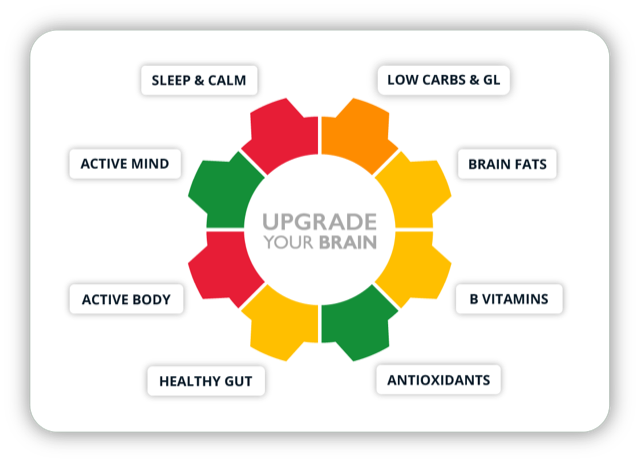
Important: Not every risk factor identified in the study fits neatly within the 8 Domains. Factors such as APOE ε4 genetic status cannot be modified, while others, including hearing impairment and socioeconomic deprivation, require consideration beyond nutrition and lifestyle. The 8 Domains are therefore best understood as a framework for addressing modifiable areas of brain health, rather than an explanation for every factor associated with dementia.
|
||||||||||||||||||||||||||||||||||||
What does this mean for dementia prevention?
For many years, dementia was often talked about as something that simply happened as we got older.
The science is giving us a more hopeful and more useful picture.
Age and genetics remain important, and there is no guaranteed way to prevent dementia. But research increasingly points towards potentially modifiable factors that may influence our risk.
This study adds another piece to that picture, particularly because it looked specifically at dementia occurring before the age of 65.
It also reinforces why we shouldn’t think about brain health in terms of one magic food, nutrient, supplement or lifestyle change.
Our brains are connected to the health of the rest of our bodies.
Blood sugar matters. Cardiovascular health matters. Physical activity matters. Nutrition matters. Mental wellbeing and social connection matter too.
That’s the thinking behind our 8 Domains of Brain Health: looking at brain health as a whole and identifying practical areas where we can take action.
Reducing the risk of young-onset dementia
One of the most important messages from this research is that dementia risk isn’t just about the genes we inherit.
Several of the factors linked to young-onset dementia are things we can potentially influence, from our metabolic and cardiovascular health to physical activity, nutrition, mental wellbeing and social connection.
That’s why prevention matters.
We can’t change every risk factor, but we can identify the ones we can influence and take positive steps to protect our brain health. And the earlier we start, the more opportunity we have to build habits that support a healthy brain throughout life.
This is at the heart of Food for the Brain’s approach: know your risk, understand what you can change, and take action.
The 8 Domains of Brain Health make that science practical, helping you focus on the areas of nutrition and lifestyle where you can make a difference.
The bigger picture
The message from this research is a positive one: our genes are not the whole story when it comes to brain health.
The study identified factors across metabolic and cardiovascular health, nutrition, physical strength, mental wellbeing and social connection. While we can’t influence all of them, there are many areas of our health and lifestyle where we can take action.
That’s what makes prevention so important.
Looking after our brain health isn’t something that needs to wait until we’re older or until we notice changes in our memory. The choices we make throughout life can help create the conditions for a healthier brain.
For us, that’s the bigger picture: understand your risk, focus on what you can change, and start looking after your brain today.
Thank you for reading!
Food for the Brain is a non-for-profit educational and research charity that offers a free Cognitive Function Test and assesses your Dementia Risk Index to be able to advise you on how to dementia-proof your diet and lifestyle.
By completing the Cognitive Function Test you are joining our grassroots research initiative to find out what really works for preventing cognitive decline. We share our ongoing research results with you to help you make brain-friendly choices.
Please support our research by becoming a Friend of Food for the Brain.
References
1 – https://pubmed.ncbi.nlm.nih.gov/36565128/
2 – https://pubmed.ncbi.nlm.nih.gov/38147328/