A thought piece on the role of marine nutrients in human brain development from our founder, Patrick Holford
It is not strength, speed, or even genes that set Homo sapiens apart.
It is the brain.
Especially the cortex, which is around three times larger than that of our closest relatives. Yet we share almost the same DNA, so something else must explain how we became so cognitively advanced.
The brain’s origin, for all species, lies in the ocean, as that is where life began. Millions of years ago, a rudimentary eye cell called a dinoflagellate, a type of marine phytoplankton, used a specific fat, the omega-3 fatty acid docosahexaenoic acid (DHA), to convert solar photon energy into the first nerve impulse, or twitch, toward food. That twitch marks the origin of the nervous system and brain.
Back in the 1980s, when zoologist Professor Michael Crawford analysed the types of fat in different animals, he found that their organs and muscles varied according to their dietary environment. All except the brain. He discovered that the brain is always rich in DHA. The more DHA, the more intelligent the animal, with humans (and sea mammals) having exceptionally high levels.
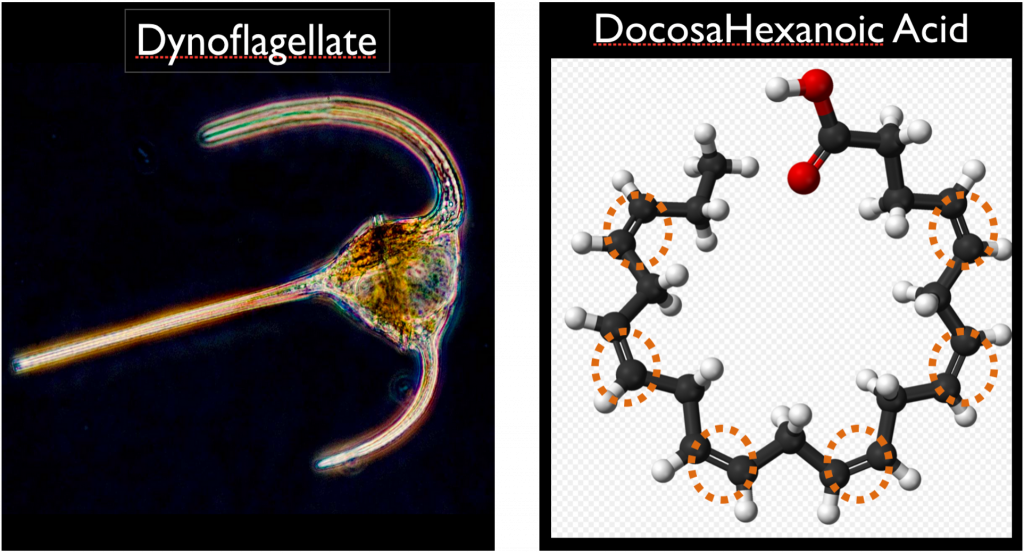
Recently, it has been proposed that DHA (docosahexaenoic acid) has a unique structure involving six double bonds arranged in a horseshoe shape, which may give it semiconductor-like properties and unique electrical characteristics. Its close relatives, ALA (alpha-linolenic acid), found in foods like chia and flax, and EPA (eicosapentaenoic acid), found in fish oil, do not share this potential.
It’s all about DHA. Although the body can convert small amounts from EPA, and even less from plant-based ALA found in foods such as chia seeds, this process is highly inefficient. In practice, meaningful amounts of DHA come primarily from marine sources.
Over six million years ago, our hominid ancestors split from other apes (chimpanzees, gorillas, and bonobos), eventually culminating in Homo sapiens around 100,000 years ago. It was not genes alone that made us different. We share 98.5% of our genome with these species. Instead, it was likely the environment our ancestors exploited. During this time, brain size steadily increased, reaching around 1.45 kg about 10,000 years ago, roughly three times the size of a chimpanzee brain, which averages about 384 g.
Humans differ from other apes in many anatomical, physiological, and biochemical ways, as well as in our psychological development, particularly intelligence and language. More than anything, it is our brain, especially its size, that sets us apart.
Before looking at the circumstances and diet that may have driven this increase in brain size and intelligence, it is worth first considering these fundamental differences. These have been clearly outlined in The Waterside Ape by ear, nose, and throat surgeon Peter Rhys-Evans, who explores why we:
The story we’ve all been told is that we came out of the trees, moved onto the savannah, and stood upright to hunt. But anyone who has been on safari will know two things. First, you don’t catch animals by standing upright, you crawl. Second, the most effective hunters are far faster than humans. Lions can reach 80 kph, leopards 60 kph, cheetahs 100 kph, while humans rarely exceed 30 kph. Four legs are simply more efficient than two.
But even beyond this, can this shift from trees to savannah really explain the other changes we see, let alone our increase in intelligence? If so, how did we suddenly develop manual dexterity, along with the ability to make tools and spears, simply to survive?
And what about populations such as the ‘sea nomad’ tribes, including the Moken and Bajau, who can hold their breath for up to ten minutes, spend hours each day in the sea, and even give birth in water? Their spleens are adapted to oxygenate tissue during long dives, much like dolphins. Where did that evolutionary adaptation come from?
The only logical explanation that I have encountered, which eloquently fits all these adaptations, is that our hominid ancestors exploited the waterside, wetlands, swamplands, rivers, estuaries, and coasts. In the process of doing so, they became upright and started to eat a diet high in marine foods, providing the essential nutrients for brain development, that is omega-3 DHA, phospholipids, plus vitamin B12, iodine, and other essential elements from magnesium to selenium.
From this perspective, let’s look more closely at the differences listed above between humans and other apes:
Part of the idea of the ‘savannah’ theory is that food became scarce with climate changes, so we switched to hunting. But the water’s edge was, until recently, abundant with easily accessible food. Even 200 years ago, in 1706, Daniel Defoe wrote this regarding the Firth of Forth: “Off the Pentland Firth the sea was one third water and two thirds fish; the operation of taking them could hardly be call’d fishing, for they did little more than dip for them into the water and take them up.” Our estuaries were packed with mussels, oysters, and crabs.
Historically, wherever early man is found, so too is evidence of seafood consumption, with remains of shells, fish bones, etc. From Pinnacle Point in South Africa, where early remains are found together with seashells, to Wales. When a 40,000-year-old Homo sapiens was found in the Gower Peninsula, DNA evidence showed that a quarter of their diet was seafood.
A marine food diet, high in critical brain-building nutrients like DHA, phospholipids and B12, is the best explanation for our cerebral expansion. “Docosahexaenoic acid (DHA), the omega-3 fatty acid that is found in large amounts in seafood, boosts brain growth in mammals. That is why a dolphin has a much bigger brain than a zebra, though they have roughly the same body sizes. The dolphin has a diet rich in DHA. The crucial point is that without a high DHA diet from seafood we could not have developed our big brains. We got smart from eating fish and living in water.” says Crawford.
The dry weight of the brain is 60 per cent fat, and DHA makes up over 90 per cent of the structural fat of neurones (brain and nerve cells). The intelligent membrane that makes up all neurones is composed of phosphorylated DHA, that is, DHA attached to phospholipids. The most abundant phospholipid is phosphatidylcholine, found predominantly in fish, eggs, and organ meats. These are bound together by a process called methylation, which is dependent on vitamins B12, folate, and B6. While folate and B6 are found in both plant foods and seafood, B12 is found predominantly in foods of animal origin and is especially high in marine foods.
The evidence suggests we were eating a diet rich in marine foods, as well as plant foods along the water’s edge, enjoying ‘fruits de mer’. It is thought that we would have eaten much more than we do today, at least double the calories. Today’s world of convenience has dramatically reduced the calories we need to expend to hunt and gather food, travel, and stay warm.
The idea that we once ate more, with at least a quarter of our diet coming from marine foods, helps make sense of what we now understand about optimal intakes of key brain nutrients, including omega-3 fats rich in DHA, phospholipids, and vitamin B12. A lack of these is strongly linked to today’s high rates of dementia. This would be equivalent to at least half of our diet today needing to come from marine foods rich in fats.
Optimal amounts of omega-3 from seafood are estimated at 2 grams a day by Joseph Hibbeln at the US National Institutes of Health, while choline is estimated at 400 mg to 800 mg. An optimal intake of B12 is probably 10 micrograms. This is not easy to achieve, even if you’re eating seven servings of oily fish a day. (Choline is rich in all fish, but DHA is only rich in oily fish, fish roe, and liver.)
In the chart below, the last column combines EPA and DHA and shows the amount provided in an 85 g serving. None provides 2,000 mg, although they do get close, suggesting that we would have needed to eat at least a serving of fish or seafood a day, if not more.
Table 1. Which Fish Is Best for Brain Health? EPA and DHA Content per 85g
| Fish and Seafood (per 85g) | EPAmg | DHAmg | EPA+DHAmg |
| Atlantic Salmon (farmed) | 587 | 1238 | 1825 |
| Atlantic Herring | 773 | 939 | 1712 |
| Atlantic Salmon (wild) | 349 | 1215 | 1564 |
| Bluefin Tuna | 309 | 970 | 1279 |
| Mackerel (canned) | 369 | 677 | 1046 |
| Sockeye Salmon (wild) | 451 | 595 | 1046 |
| Rainbow Trout (farmed) | 284 | 697 | 981 |
| Sardines (canned) | 402 | 433 | 835 |
| Albacore (or white) Tuna (canned) | 198 | 535 | 733 |
| Shark (raw) | 267 | 444 | 711 |
| Swordfish | 117 | 579 | 696 |
| Sea Bass | 175 | 473 | 648 |
| Pollock | 77 | 383 | 460 |
| Flat Fish (Flounder/Sole) | 207 | 219 | 426 |
| Halibut | 77 | 318 | 395 |
| Oysters (farmed) | 195 | 179 | 374 |
| Dungeness Crab | 239 | 96 | 335 |
| Scallops | 141 | 169 | 310 |
| Mixed Shrimp | 145 | 122 | 267 |
| Clams | 117 | 124 | 241 |
| Yellowfin Tuna | 40 | 197 | 237 |
| Catfish (wild) | 85 | 116 | 201 |
| Catfish (farmed) | 42 | 109 | 151 |
| Cod | 3 | 131 | 134 |
| Mahi-Mahi (dolphin fish) | 22 | 96 | 118 |
| Tilapia | 4 | 111 | 115 |
Brain size remains reasonably constant from 100,000 to 10,000 years ago, then starts to shrink, perhaps coinciding with the birth of agriculture and diets based more on meat, milk, and plants than marine foods. Today, the average brain size is 1.35 kg.
(This is why we developed and offer omega-3 at-home blood tests, alongside other essential biomarkers, so you can know exactly what is happening in your body and how to protect your brain. Find out more about testing here.)
Apart from brain size and, more pertinently, brain-to-body size ratio, what sets us apart from other animals is self-awareness. Animals have the equivalent of thoughts and feelings, but humans are relatively unique in being able to witness their own thoughts and feelings. That is self-awareness. This is not an easy thing to measure, but some other mammals, notably dolphins, gorillas, and chimpanzees, also have a degree of self-awareness. Other contenders for higher cognition include octopuses and elephants, all large-brained creatures.
However, it isn’t just size that counts. In essence, there are three evolutions of the brain. First, the reptilian brain, located in the brain stem, which programmes basic survival needs. Then there’s the mammalian brain, with more cognitive and emotive functions (think dog), and then the neocortex, associated with higher cognition. But while elephants have larger brains, they have smaller neocortices. It was the neocortex that started to grow in our hominid ancestors.

The richest concentration of ancient rock art over 6,000 years ago, however, is found in sub-Saharan Africa, the Nile Valley, and the Red Sea hills, then a green belt with vast lakes, rivers, and wetlands, hence abundant marine foods, which lasted until about 3,500 years ago, when much of Egypt became a desert. Whether the drying up of the Sahara was linked to the Younger Dryas (see below), a change in the Earth’s tilt, or overgrazing is a subject of debate.
Meanwhile, groups of our early ancestors who had left Africa, living in Europe as far west as Ireland, as far north as Scandinavia, and as far east as China and Australia, were also struck by cataclysmic weather changes. In Europe, the Magdalenian culture, known for its advanced stonework, emerged around 17,000 years ago, towards the end of the Ice Age. It lasted until around 12,000 years ago, when it coincided with the Younger Dryas, a period of extreme cooling that lasted for approximately 1,000 years and may have been triggered by a meteor event.
One theory has our ancestors migrating south, towards warmer climates with available water, possibly carrying with them the sticky grains they had previously gathered, and planting them in moist soil as a means of survival, thus giving birth to the agricultural age, whereby humanity moved away from a hunter-gatherer lifestyle towards an agricultural one. This also makes sense, as these two pockets of humanity, in Mesopotamia (now Iraq), between the Tigris and Euphrates rivers, and in Egypt, became more densely populated, with the need for stored food supplied by grains and domesticated animals. This stable food supply would have allowed the expansion of these populations. (There is another evolutionary hotspot in Asia and China.)
Globally, there is currently an increase in mental illness, which is fast becoming the biggest health threat, according to the World Health Organization (and why I founded Food for the Brain). There is also evidence that our brain size has reduced by 10 per cent, from 1.45 kg 10,000 years ago to an average of 1.35 kg today, coinciding with a more land-based food supply. According to Scandinavian research, our IQ is also falling by 7 per cent per generation.
Global rates of depression, dementia, suicide, and stress-related disorders such as anxiety and insomnia are escalating. One in six children in the UK are classified as having ‘special educational needs’ (SEN). Suicide, globally, has become the most common cause of violent deaths, ahead of all wars and murders. In the UK, 790 people a day, equivalent to nine double-decker buses’ worth, are diagnosed with dementia. Global incidence will top 100 million this decade, already costing over 1% of GDP.
If we assume that our brains still require a similar supply of nutrients to those available during peak periods of brain evolution, the gap today becomes hard to ignore. We are simply not achieving the same intake of essential fats, phospholipids, and micronutrients. Plus, you could argue that the demands of the digital age have put more stress on us, increasing these needs further.
Against this backdrop, it is no surprise that mental health is in decline. With a growing population, declining seafood availability, and increasing contamination from heavy metals, PCBs, and microplastics, this trend may worsen.
High sugar intake in animals has been shown to lead to shrinkage of the brain’s hippocampal region. This is where the nucleus accumbens, the seat of the brain’s dopamine-based ‘reward’ system, stimulated by sugar, caffeine, and tech addiction, resides. Marketeers have learnt how to create addiction to their products by stimulating the reward system, selling short-term pleasure, the dopamine-based feeling, in the guise of happiness. The happy hour, the happy meal, happiness in a bottle, etc. Overstimulation of the reward system ultimately leads to dopamine depletion and brain cell death, coupled with a decline in serotonin, the tryptamine associated with happiness, connection, love, empathy, and other essential qualities of a harmonious society, the very qualities that make us human.
We are therefore witnessing the devolution of the brain, the decline and fall of mental health and harmonious society, a situation that is likely to get worse as the population expands, unless we learn how to optimally nourish the brain.
The emphasis in human nutrition has, for too long, been on the body. With more protein intake, we have grown taller, but not smarter. As Director of the Institute of Brain Chemistry at Chelsea and Westminster Hospital, Professor Michael Crawford has been able to accurately predict which pregnant people are most likely to have pre-term babies, with an increased risk of cognitive delay or impairment. This is based on determining the supply of DHA by analysing the pregnant woman’s blood. In its absence, levels of a surrogate fat, oleic acid, rise to fulfil the requirement of the neonatal brain when DHA is in short supply. It is, however, an inadequate substitute, and thus cognitive development is impaired. Babies born to mothers with low blood DHA levels, compared to those supplementing DHA, have smaller brains.
According to Crawford, with a growing population and shrinking fish supply, we must develop marine agriculture on a massive scale to survive and protect the brain. In the same way that man moved from hunter-gatherer on the land to peasant farmer, we too must move from hunter-gatherer in the oceans to marine farmer. In Japan, he has been instrumental in the creation of artificial reefs in estuaries to attract back the marine food web, from mussels to crustaceans and fish, as well as farming seaweed on a massive scale. By processing seaweed, it is possible to create DHA, the critical brain fat that is crucially lacking in a plant-based diet. As Crawford says, “We now face a world in which sources of DHA, our fish stocks, are threatened. That has crucial consequences for our species. Without plentiful DHA, we face a future of increased mental illness and intellectual deterioration. We need to face up to that urgently.”
At the other end of the lifecycle, more and more older people are slipping into dementia, which is a preventable but not reversible condition. At the University of Oxford, Professor David Smith has shown that inadequate omega-3 fats (DHA and EPA) and B vitamins, especially vitamin B12, are the principal drivers of cognitive decline. Yet, by providing these nutrients to those with pre-dementia, further memory decline and brain shrinkage can be arrested. B12 is predominantly found in animal foods and is especially rich in seafood. A plant-based diet alone does not provide sufficient DHA, B12, or phospholipids required for optimal brain development.
Therefore, it is vital that the needs of optimal brain function be placed at the top of the health agenda to prevent the decline in our mental health and, potentially, the fall of Homo sapiens. Without properly supporting brain health, we risk undermining our ability to think clearly, adapt, and work together in the face of growing pressures on our food systems, environment, and resources.
If this story tells us anything, it is that the brain responds to its environment, and that includes what we eat and how we live.
The encouraging part is that there is so much we can do, right now, to support our brains. Not just to feel clearer, more energised, and resilient through every stage of life, but to shape the health of the next generation too.
At Food for the Brain, our mission is simple: to give everyone the tools to understand their brain and know how to nourish it properly.
Here are three simple steps you can take this week to begin protecting your brain:
Use our free, validated online assessment to get in-depth information on how your brain is performing today.
Measure key biomarkers linked to cognitive health, including omega-3, vitamin D, and blood sugar balance
Create the right habits for your brain. When you become a Friend of Food for the Brain, you get access to the COGNITION™ programme, with practical, step-by-step guidance to help you support and upgrade your brain over time. Because you need to know what to do and have the help to ensure you do it.
Food for the Brain is a non-for-profit educational and research charity that offers a free Cognitive Function Test and assesses your Dementia Risk Index to be able to advise you on how to dementia-proof your diet and lifestyle.
By completing the Cognitive Function Test you are joining our grassroots research initiative to find out what really works for preventing cognitive decline. We share our ongoing research results with you to help you make brain-friendly choices.
Please support our research by becoming a Friend of Food for the Brain
Astrobiology Magazine. How Earth’s orbital shift shaped the Sahara. Available from: https://www.astrobio.net/news-exclusive/how-earths-orbital-shift-shaped-the-sahara/
See also: Phys.org. Sahara swung between lush and desert conditions. Available from: https://phys.org/news/2019-01-sahara-swung-lush-conditions-years.html
See also: NOAA National Centers for Environmental Information. End of the African Humid Period. Available from: https://www.ncdc.noaa.gov/abrupt-climate-change/End%20of%20the%20African%20Humid%20Period
Younger Dryas impact hypothesis. Wikipedia. Available from: https://en.wikipedia.org/wiki/Younger_Dryas_impact_hypothesis
Cyranoski D. How China is rewriting the book on human origins. Nature. 2016. Available from: https://www.nature.com/news/how-china-is-rewriting-the-book-on-human-origins-1.20231
YouTube. [Video resource]. Available from: https://www.youtube.com/watch?v=t9Zjd0TIHsY
Hardy K, Brand-Miller J, Brown KD, Thomas MG, Copeland L. The importance of dietary carbohydrate in human evolution. Q Rev Biol. 2015;90(3):251–268.
Discover Magazine. The human brain has been getting smaller since the Stone Age. Available from: https://www.discovermagazine.com/planet-earth/the-human-brain-has-been-getting-smaller-since-the-stone-age
Ogundipe E, Tusor N, Wang Y, Johnson MR, Edwards AD, Crawford MA. Randomized controlled trial of brain specific fatty acid supplementation in pregnant women increases brain volumes on MRI scans of their newborn infants. Prostaglandins Leukot Essent Fatty Acids. 2018;138:6–13. doi:10.1016/j.plefa.2018.09.001