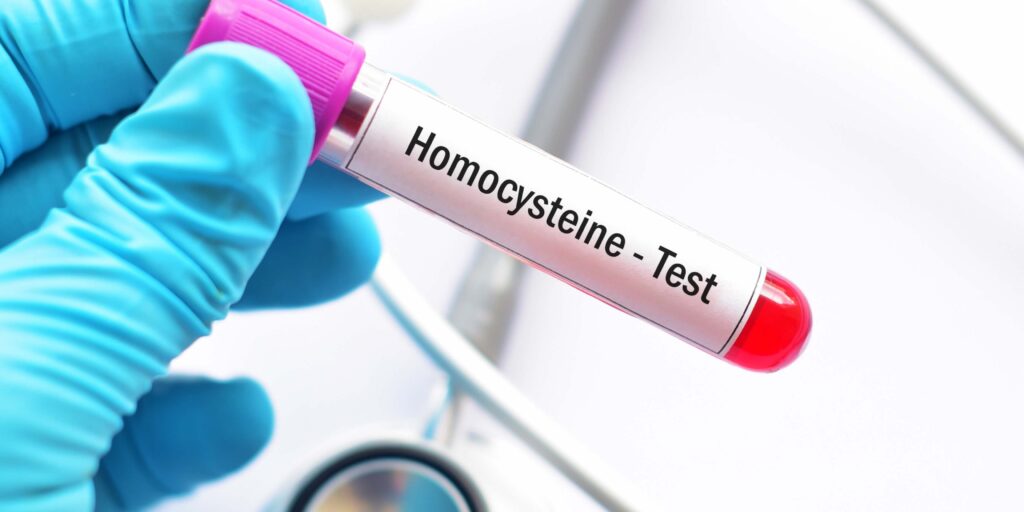
A homocysteine test is a simple blood test that measures the level of homocysteine in your body.
Homocysteine is a naturally occurring amino acid, but its blood level reflects something deeper. It gives insight into a fundamental process called methylation, which is involved in everything from brain chemistry to detoxification and DNA regulation.
Because this process depends heavily on vitamins B12, B6, and folate, experts widely consider homocysteine one of the most useful functional markers of B vitamin status [1].
It is not a diagnostic test. It is a window into how well your body is functioning.
Once you’ve received your homocysteine test result, the next step is understanding what it means. Read our guide to Homocysteine Levels Explained to learn how to interpret your result, what is considered an optimal level, and what elevated homocysteine may indicate.
Homocysteine is a useful blood marker because it can show how well key processes in the body are working, rather than simply what is present. Most blood tests measure levels of substances, while homocysteine can give insight into methylation, B vitamin status, and wider metabolic health.
When homocysteine rises, it often signals that important systems are under strain. This can reflect suboptimal methylation, insufficient B vitamins, or wider imbalances affecting the brain, cardiovascular system, and beyond.
Research has consistently linked higher levels with changes in vascular health and cognitive ageing.
[1,2]. This is why homocysteine has become a focus of research in prevention, not just disease.
Importantly, homocysteine often shifts before more obvious symptoms appear, making it useful for early insight rather than late-stage investigation.
For more information, read this homocysteine and brain health overview, which explains the connection between elevated homocysteine levels, cognitive decline, and long term brain health.
Testing homocysteine gives you a clear, actionable number. From this, you can begin to understand:
This is why experts often describe homocysteine as a functional marker. It reflects how your biology is operating in real time, not just whether you fall within a reference range.
The Food for the Brain at-home homocysteine blood test is designed to be simple, reliable, and easy to do at home:
Historically, homocysteine has been difficult to measure outside of clinical settings due to its instability in blood samples. Advances in dried blood spot technology have made accurate at-home testing possible, with validation studies showing strong agreement with standard plasma measurements [3]. This means you can now access accurate testing with the convenience of doing it from home.
Homocysteine testing can be useful for anyone interested in understanding and optimising their long-term health, particularly:
You cannot reliably predict your homocysteine level from your diet, symptoms or lifestyle alone. Although factors such as B-vitamin intake, age, smoking and alcohol consumption can influence homocysteine, someone with an apparently healthy diet can still have an elevated level. A blood test is the only way to establish your actual homocysteine level.
It is also a valuable marker for tracking progress over time.We generally recommend it for older adults, but you can use our homocysteine or DRIfT test from age 2+.
An optimal homocysteine level is often considered lower than the standard laboratory “normal” range. Most laboratories define normal homocysteine as below around 10 µmol/L, but research suggests that lower levels may be more protective, particularly for brain health.
Higher homocysteine has been linked to increased brain atrophy and faster cognitive decline in at-risk populations [2].
At Food for the Brain, we typically aim for levels closer to 7 µmol/L or below as an optimal target.
This is not about chasing perfection, it is about recognising that “normal” does not always mean optimal.
Your result provides a starting point.
If levels are elevated, there are well-established ways to bring them down, including targeted nutrition, lifestyle changes, and support for B vitamin status [1], and we can guide you in this via our COGNITION programme. Homocysteine levels can often improve within a matter of months, making it a useful marker to retest and track.
This is where testing becomes powerful, not as a label, but as a guide.
Food for the Brain offers homocysteine testing that goes beyond simply providing a result. We combine scientifically validated at-home testing with expert guidance focused on long-term brain and metabolic health. As a charity dedicated to dementia prevention and cognitive wellbeing, we ground our work in research, education, and practical action. We design your test result to be meaningful, helping you understand your current status, identify areas for improvement, and take clear next steps through personalised support such as our COGNITION programme.
Food for the Brain offers a convenient at-home, finger-prick homocysteine test designed for high analytical accuracy. Traditionally, clinicians have measured homocysteine using a venous blood sample, which requires rapid processing and centrifugation.
In partnership with our laboratory team, we have developed a method to stabilise the sample, helping to ensure reliable results while making testing more accessible.
You can measure your levels using the Food for the Brain Homocysteine (HCY) test, or as part of the DRIfT test, which includes a broader range of biomarkers linked to brain health.
Further details on the validation of this method can be found in our homocysteine blood test validation document.
Yes. Our homocysteine test uses accurate, scientifically validated methods. You can view our validation document for full details.
While much of the published research measures homocysteine in plasma (the clear part of the blood), our test uses a dried whole-blood sample analysed using LC-MS technology. Researchers have validated this method against plasma homocysteine testing, giving you a reliable and convenient way to test from home.
Yes. The test is available in EU countries, the US, Australia, Canada, Japan, Malaysia and Singapore and New Zealand. Your kit also includes a prepaid return envelope that can be used from all supported countries.
Some factors can affect your homocysteine level and may influence your result. We recommend avoiding coffee, nicotine (including cigarettes and e-cigarettes), alcohol, and certain medications such as antibiotics for at least 2 hours before the test, and ideally for 12 hours alongside overnight fasting.
Because vitamins B6, folate, and B12 can help lower homocysteine levels, it is best to avoid supplements containing these nutrients for 12 hours before testing, and ideally for 24 hours, to give a more accurate reflection of your baseline level.
Yes. We recommend fasting overnight, or for at least 12 hours before taking your sample. For example, if you plan to take the test at 8 am, aim to finish dinner by 8 pm the night before.
This is because eating a high-protein meal shortly before testing can temporarily raise homocysteine levels, which may affect your result. Most research studies also use fasting samples to reduce this variable.
Please drink only water before taking your finger-prick blood sample.
Morning, before breakfast, is usually the most practical time to take your sample, especially if you are fasting overnight. However, the time of day does not matter as long as you follow the recommended preparation guidance.
No. There is no upper or lower age limit for taking the test. Homocysteine levels can be an important indicator of health at any age.
Certain medications, supplements, and lifestyle factors can affect homocysteine levels and may influence your result.
These include antibiotics, metformin, proton pump inhibitors (PPIs), diuretics, and supplements containing vitamin B6, B12, folic acid, or folate. Coffee and alcohol may also temporarily affect levels.
For the most accurate result, we recommend avoiding these for 12 hours before taking your sample, and ideally 24 hours where possible, unless your doctor has advised otherwise. If you are taking antibiotics regularly, it may be best to wait until your course has finished before testing.
Please allow 2 to 4 weeks from the date of posting your sample collection card to receive your results.
We will email you when your sample arrives at the laboratory, so you know we are processing your results.
Eating foods rich in vitamin B6, B12, and folate can help support healthy homocysteine levels and is strongly recommended.
Vitamin B12 is found mainly in fish, meat, milk, and eggs. Foods such as seeds, nuts, beans, lentils, vegetables, and especially leafy greens provide folate and vitamin B6. If your homocysteine level is above 10 µmol/L, consider supplementation alongside dietary changes. For more guidance, please read Lowering Homocysteine with Supplements.
If your homocysteine level is above 10 µmol/L, we recommend retesting after three months. The right nutritional and lifestyle steps can often improve homocysteine levels within this time.
If your level is already in the optimal range, testing once a year is usually enough to help make sure it stays there.
Ready to understand your homocysteine level? Order your at-home test today and get clear insight into brain, heart, and B vitamin health.