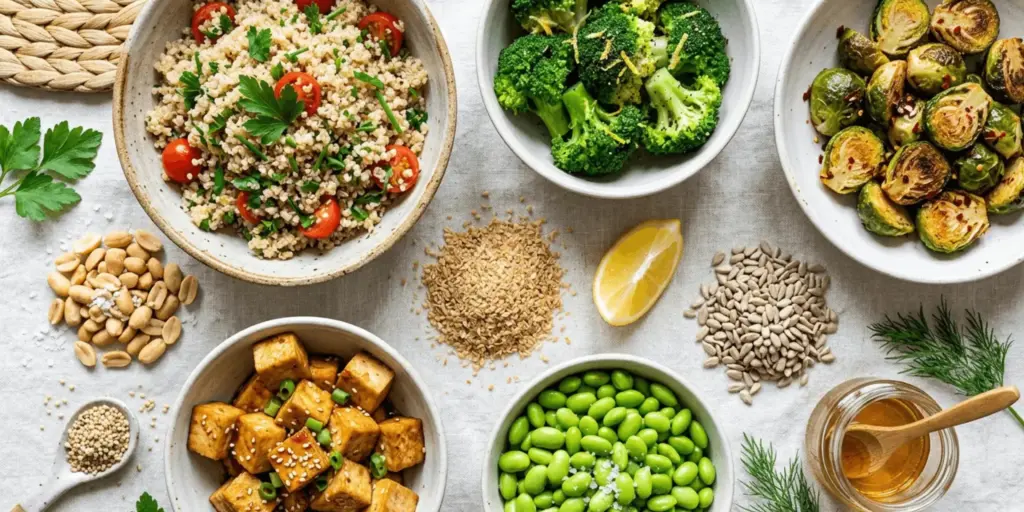
Did you know your brain is largely built from fat? Phospholipids and choline are an important part of that story. Brain-cell membranes are rich in phospholipids, which combine with DHA, the long-chain omega-3 fat particularly important for the brain. Fish and eggs provide both these nutrients, but on a vegan diet you need to think about them separately: where your DHA is coming from, and whether you are getting enough choline to support phospholipid production. The good news is that both can be covered without eating fish or eggs. Here’s how, including the vegan choline sources that genuinely add up.
Flaxseed, walnuts and chia give you ALA, a plant omega-3, but converting it into the DHA your brain actually needs is remarkably inefficient. The classic human tracer study found women convert around 9% of ALA into EPA at best, men considerably less, and conversion all the way to DHA is lower still, often under 1%.[1] In practice, that means a vegan diet without a direct DHA source usually falls short, whatever the flaxseed packet implies.
The fix is algae oil: it’s the same DHA fish get from eating algae in the first place, just without the fish, and a 2025 study found algae-derived EPA and DHA absorb just as well as fish oil at equivalent doses.[2] For brain health, research suggests that higher intakes may be needed than standard minimum omega-3 recommendations, with studies reporting cognitive benefits at DHA intakes above approximately 580mg a day. A practical target is around 750mg DHA a day, alongside EPA, giving a combined EPA and DHA intake of over 1,000mg a day. If you want to know where you actually stand rather than guess, an Omega-3 Index test measures it directly.
For DHA to become part of a brain-cell membrane, it needs to be incorporated into phospholipids. B vitamins, particularly B12, folate and B6, are involved in the methylation pathways that help make and regulate these phospholipids. Homocysteine gives us a useful window into how well these B-vitamin-dependent pathways are working: when levels are raised, it can be a sign that something in this system needs attention.
Think of DHA as the building material and phospholipids as the structure that puts it in the right place. Having plenty of DHA arriving at the building site is important, but you also need the machinery and materials to build it into the membranes your brain cells depend on.
Several phospholipid types exist (phosphatidyl choline, serine, inositol, ethanolamine), and your body makes some of each, but not enough on its own for optimal brain health. Egg yolk and liver are the richest phospholipid food sources, which is exactly why this needs a separate approach on a vegan diet. That’s why choline is best thought of as semi-essential, and why it’s increasingly treated as a nutrient worth tracking deliberately rather than assuming you’re getting enough.
The evidence for paying attention to choline has only grown stronger. In a large 2025 UK Biobank study of more than 125,000 people followed for almost 12 years, moderate choline intake was associated with a 17–23% lower risk of dementia compared with lower or higher intakes.[3] The relationship was U-shaped, with the lowest risk seen at around 330–354mg a day. Read FFB’s full coverage of that study here .
Current EU guidance (EFSA) sets adequate intake at 400mg a day for adults generally, rising to 480mg in pregnancy and 520mg during breastfeeding.[4] There’s no separate UK (SACN) reference value, so this EU figure is what most UK sources, including in our founder Patrick Holford’s own books,
Fish, eggs and organ meats remain the richest sources overall, but the best vegan choline sources are soya (tofu, soya milk), quinoa, nuts and seeds (flaxseed, almonds, peanuts), and cruciferous vegetables: broccoli, cauliflower, Brussels sprouts. Worth noting: serving size matters as much as the food itself. Soya flour looks unimpressive per serving but is one of the most concentrated sources by weight, so it’s worth using where you can (a smoothie or baking flour, for instance) rather than judging foods by the 100g figure alone.
| Food | Typical serving | Choline per serving | Choline per 100g |
|---|---|---|---|
| Egg, whole, hard-boiled | 1 large | 147mg | Varies by preparation* |
| Salmon, Atlantic, farmed, cooked | 100g | 91mg | 91mg |
| Roasted soya beans | ½ cup | 107mg | Varies by product |
| Soya milk | 250ml (~250g) | 60mg | 24mg |
| Shiitake mushrooms, cooked | ½ cup | 27mg | Varies by preparation |
| Soya flour, defatted | 12.5g | 24mg | 190mg |
| Green peas, cooked | ½ cup (~80g) | 24mg | 28mg |
| Quinoa, uncooked | 60g | 42mg | 70mg |
| Quinoa, cooked | 1 cup | 43mg | ~23mg |
| Pinto beans, dry | 60g | 40mg | 66mg |
| Kidney beans, canned | ½ cup | 45mg | ~33–35mg |
| Broccoli, cooked | ½ cup | 31mg | 40mg |
| Brussels sprouts, cooked | ½ cup | 32mg | 41mg |
| Cauliflower, cooked | ½ cup | 24mg | 39mg |
| Tofu, firm | 125g | 35mg | 28mg |
| Chickpeas, cooked | ½ cup | ~35mg | ~43mg |
| Baked beans, canned, plain or vegetarian | 100g | 32mg | 32mg |
| Flaxseeds | 28g | 22mg | 79mg |
| Pistachios, dry roasted | 28g | 20mg | 71mg |
| Pine nuts | 28g | 16mg | 56mg |
| Cashews, oil roasted | 28g | 17mg | 61mg |
| Wholewheat bread | 2 slices (~60g) | ~16mg | 27mg |
| Almonds | 28g | 15mg | 52mg |
| Peanuts, dry roasted | ¼ cup | 24mg | ~69mg |
| Peanut butter | 1 tbsp (~16g) | ~10mg | 61–66mg |
| Wheat germ, toasted | 1 tbsp (~7g) | ~13mg | 180mg |
| Avocado | ½ medium (~75g) | ~11mg | 14mg |
Sources: USDA Database for the Choline Content of Common Foods, Release 2; USDA FoodData Central; and NIH Office of Dietary Supplements. Values are approximate and may vary according to variety, brand, processing and cooking method.
*Egg values are best expressed per egg because choline concentration varies according to preparation and the specific database entry. NIH gives 147mg of choline for one large hard-boiled egg.
For context, there is currently no UK Dietary Reference Value specifically for choline. EFSA sets an Adequate Intake of 400mg/day for adults. US Adequate Intakes are 425mg/day for adult women and 550mg/day for adult men.
Put together, a full day of vegan eating looks like this:
| Meal | Foods | Choline | Meal total |
|---|---|---|---|
| Breakfast |
Soya milk Small handful of nuts or seeds |
57mg 20mg |
77mg |
| Lunch |
Cooked quinoa (⅓ cup raw) Broccoli, cauliflower or Brussels sprouts (100g) Half an avocado |
43mg 36mg 14mg |
93mg |
| Snacks |
Almond or peanut butter (1 tbsp) Hummus (½ cup) Wholegrain bread (2 slices) |
10mg 34mg 17mg |
61mg |
| Dinner |
Tofu or beans (125g) Shiitake mushrooms (½ cup) Broccoli, cauliflower or Brussels sprouts (100g) |
35–40mg 27mg 36mg |
98–103mg |
| Daily total | 329–334mg | ||
That adds up to roughly 330mg across the day: a solid base, and still short of the 400mg+ target.
To get from around 330mg through food to 500mg or more, you may want to supplement rather than trying to eat your way there. Lecithin granules and capsules are the most concentrated phosphatidylcholine sources available, and soya is the source almost all vegan phosphatidylcholine supplements are made from (egg-derived lecithin isn’t vegan, so check the label). One tablespoon (7.5g) of standard soya lecithin granules provides roughly 200mg of choline. If you use a high-phosphatidylcholine lecithin (around 18% choline), you need less: around 5g provides a similar amount of choline.
In practice:
Eat one or two daily servings of dark green and cruciferous vegetables, such as kale, broccoli and Brussels sprouts or obtain EPA and DHA from a suitable algae-derived omega-3 source.
Have a daily serving of quinoa, beans or tofu.
Add one dessertspoon of high-PC lecithin, or two high-PC lecithin capsules, daily.
If you’re vegetarian rather than strictly vegan, meeting your choline needs is much easier. Eggs are one of the richest vegetarian sources, providing around 147 mg per large hard-boiled egg, so six eggs a week can make a significant contribution. Non-vegans can also get choline from fish, including varieties that aren’t particularly rich in omega-3.
The bigger picture is not about chasing one nutrient in isolation. Your brain-cell membranes depend on phospholipids, DHA and the B vitamins involved in bringing these systems together. On a vegan diet, all of these can be covered, but DHA and choline deserve particular attention rather than being left to chance.
The principle is simple: give your brain the raw materials it needs to build and maintain healthy cell membranes throughout life.
This information is for educational purposes only and isn’t a substitute for personalised medical advice. If you’re pregnant, breastfeeding, or planning pregnancy, speak to your GP, midwife or a qualified nutrition professional before starting any new supplement.
Related reading: