

Sugar and Cognitive Function: What We Found in Nearly 29,000 People
Sugar and Cognitive Function: What We Found in Nearly 29,000 People
Food for the Brain’s first peer-reviewed study using data from nearly 29,000 people found that more frequent consumption of sugary snacks and drinks was associated with lower cognitive function scores. Researchers analysed anonymised data from people who completed our validated Cognitive Function Test alongside questions about their diet and lifestyle.
Researchers analysed anonymised information from almost 29,000 people who completed our validated Cognitive Function Test alongside questions about their diet and lifestyle, creating an unusually large real-world dataset through which to explore the relationship between what we eat and how well we think. Among the dietary patterns examined, one stood out particularly strongly: people who reported consuming sugary snacks and drinks more frequently tended to have lower cognitive function scores.[1]
There is another reason this paper matters so much to us. These findings were made possible by people just like you. Thousands of people have chosen to test their cognitive function and contribute their anonymised information to this research, so if you were one of them, you were not simply gathering information and tools for your own brain. Collectively, you were helping us ask much bigger questions about what influences cognitive function and, ultimately, how we might protect it.
Research at a glance
Published: Frontiers in Nutrition (2026)
DOI: 10.3389/fnut.2026.1830204
Participants: ~29,000
Research: Food for the Brain / Conti et al.
Measured: Self-reported diet + Cognitive Function Test performance
Key finding: Frequent sugary snack/drink consumption associated with poorer cognitive performance
Study type: Observational
Read the peer-reviewed paper →
Nearly 29,000 people, one remarkable dataset
Since November 2022, people completing our free Cognitive Function Test have also been able to answer questions about their diet, sleep, activity and health. The test itself is validated against established cognitive measures and has been shown to distinguish between healthy individuals and those with mild cognitive impairment.[2] Over time, those individual contributions have created something scientifically valuable: a large dataset connecting measures of cognitive function with information about how people actually live.
For this first published study, researchers led by Federica Conti, working with our Head of Research Dr Tommy Wood and colleagues, analysed almost 29,000 anonymised records.[1] Rather than beginning with an assumption about which foods should matter most, they used a statistical approach called the Bias-reduced Regression Analysis in Nutrition, or BRAiN, index. In simple terms, this allowed patterns within the data to identify which reported dietary behaviours were most strongly associated with cognitive performance, rather than assigning importance to particular foods in advance.[1]
This distinction matters because nutrition research is complicated. We do not eat nutrients in isolation, foods themselves contain complex combinations of nutrients and compounds, and our food choices sit alongside differences in age, health, activity and many other aspects of our lives. No statistical method can remove all of that complexity, but analysing a dataset of this size gives researchers an opportunity to look for patterns that may be difficult to see in much smaller studies.
(It’s worth noting that this research paper explored a much broader range of dietary factors than sugar alone, with several other interesting patterns emerging from the analysis. For this article, we are focusing on one finding in particular because of its strength, its relevance across age groups and how it connects with the wider evidence around glucose regulation and brain health.)
What did the study find about sugar and cognitive function?
Of the dietary behaviours examined, the frequency of sugary snacks and drinks emerged as one of the strongest dietary factors associated with cognitive performance.[1] This category included foods and drinks such as biscuits, cakes, chocolate, sweets, fizzy drinks and fruit juice, rather than the naturally occurring sugars contained within whole fruit.
The pattern became particularly interesting when researchers looked at frequency. People reporting sugary snacks or drinks twice a day or more tended to have lower cognitive scores, while lower reported frequencies did not show the same strength of association.[1] Because the questionnaire measured how often these foods were consumed rather than exactly how much sugar people ate, we cannot turn this into a precise daily sugar limit or say that two occasions represents a biological threshold. What we can say is that, within this large group of people, more frequent consumption was associated with poorer cognitive performance.
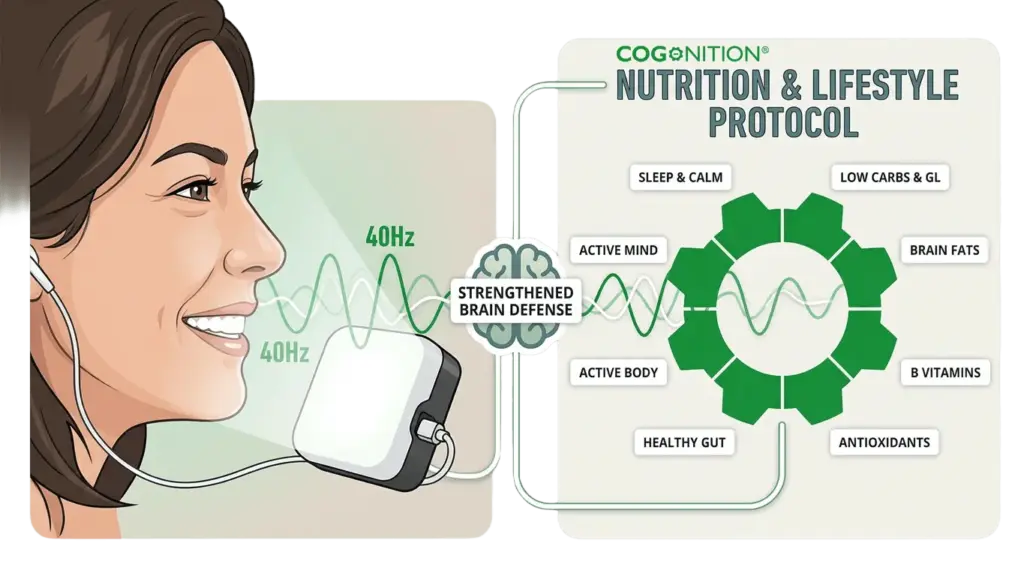
For those who have followed Food for the Brain for some time, our focus on sugar and blood glucose will not be new. Reducing sugar and refined carbohydrates, choosing whole foods and following lower glycaemic load principles have long been part of the approach we teach through COGNITION, based on the wider evidence around glucose regulation and brain health. What is exciting about this study is that when researchers analysed our own community data, frequent consumption of sugary foods and drinks emerged as one of the strongest dietary factors associated with cognitive performance.[1] It gives us new evidence from our own research community to add to a much larger body of science examining the relationships between sugar intake, glucose regulation and cognitive health.
This does not mean sugar is something to dismiss under an “everything in moderation” banner. We want whole, minimally processed foods to make up the foundation of what we eat, with sugary and highly processed foods being the exception rather than an everyday staple. At the same time, protecting your brain does not have to become another source of pressure to achieve dietary perfection. What this research highlights is the potential importance of the choices we make repeatedly over time.
Was sugar associated with cognitive function at different ages?
Perhaps one of the most interesting aspects of the study is that sugar did not emerge as relevant only among older participants. It remained among the leading dietary predictors of cognitive performance across the age groups examined, suggesting that the relationship between diet and how well we think may be relevant much earlier in adult life than conversations about dementia sometimes imply.
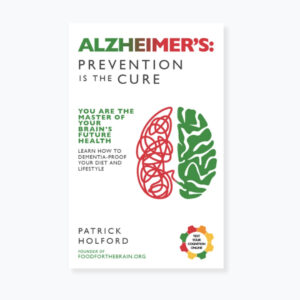
This matters to us because prevention should not begin only at the point when memory is already failing. Dementia develops over many years, and the biological processes that influence brain health do not suddenly appear in our seventies or eighties. This study cannot specifically tell us that reducing sugar in younger adulthood will prevent dementia decades later, but it adds to the case for thinking about cognitive health throughout life, an approach that has long been central to Food for the Brain. (Want to understand more then make sure you read our founder Patrick Holford’s Alzheimer’s: Prevention is the Cure.)[3]
The brain you have later is, in part, shaped by the life you live now.
Why might sugar and glucose regulation matter?
This study was designed to identify associations, not to establish the biological mechanism behind them. To understand why the finding is so interesting, however, we can place it alongside what previous research has already told us about sugar, glucose regulation and the brain.
Previous population research has found associations between habitual sugar intake and cognitive function,[4] while higher dietary glycaemic load has also been associated with poorer cognitive performance.[5] Longer-term research has found an association between higher glucose levels and increased dementia risk, including among people without diabetes.[6] Taken together, this gives us good reason to continue investigating how sugar intake and glucose regulation may influence the brain throughout life.
Professor Robert Lustig, a member of Food for the Brain’s Scientific Advisory Board and an international authority on sugar and metabolic health, explores the wider science in much more depth in his article Is Sugar Killing Your Brain?. There he looks beyond cognitive performance to research around insulin resistance, brain energy metabolism and brain structure. That wider evidence helps explain why sugar has been an important part of our prevention work, while this new study adds something different: evidence of a relationship between reported sugary food and drink frequency and cognitive performance within our own large research dataset.
Nor does any of this mean that all foods containing carbohydrate or sugar are metabolically equivalent. Whole fruit comes packaged with fibre, water and a complex mixture of nutrients and plant compounds, which is very different from consuming a sugary drink with little or no fibre. Our metabolic responses also differ, which is another reason to look beyond a single food or nutrient and consider the wider diet, lifestyle and health of the individual. The overall pattern of the diet matters, but food is only one part of the picture. Physical activity, metabolic health and keeping the brain challenged and stimulated through the “Use It or Lose It” approach are all part of protecting cognitive function throughout life, an approach explored further in Dr Tommy Wood’s book The Stimulated Mind.
There are also limits to what any observational study can tell us, and acknowledging them is part of doing good research. Participants reported their own diets and the questionnaire measured frequency rather than the exact quantity of sugar consumed. An observational study like this can also identify associations, it cannot establish that sugary foods caused the differences in cognitive performance. Other factors may contribute to the relationship, and further research will be needed to understand cause and effect.
How can you reduce sugar to support cognitive health?
Reducing sugar will look different for different people, but a useful place to begin is by looking honestly at how frequently sugary and highly processed foods are appearing in your day. If biscuits, sweets, cakes, chocolate, fruit juice or sugary drinks are showing up several times a day, reducing those occasions is a practical first step.
For many people, focusing on replacement rather than restriction can make that change easier to put into practice. Could an afternoon biscuit become yoghurt with blueberries and nuts, or a drive-through sugary coffee become coffee from home alongside a whole-food snack? These are starting points, not necessarily the end point. Some people may benefit from reducing sugar and high-glycaemic foods much more substantially, depending on their metabolic health and individual response, but shifting repeated choices away from sugar and towards whole, minimally processed foods is a practical place to begin.
This is why COGNITION focuses on lower glycaemic load principles and making whole, minimally processed foods the foundation of the diet. Vegetables, pulses, whole fruit, nuts, seeds, quality sources of protein and intact whole grains where appropriate provide much more than carbohydrate alone, including fibre and a wide range of nutrients. We also look at how foods are combined, because the effect of a meal on blood glucose is influenced by the whole meal, not simply one ingredient. These particular strategies were not tested by this study, but they draw on the wider evidence around metabolic health and turn that science into everyday habits.
You can also learn something about how well your own body has been managing blood sugar. HbA1c is a blood test that measures the proportion of haemoglobin in your red blood cells that has glucose attached to it. Because red blood cells live for around three months, this gives us a useful picture of your average blood sugar over the previous two to three months. Put very simply, the higher your average blood sugar has been, the more haemoglobin becomes glycated, or “sugar-coated”, and the higher your HbA1c is likely to be.
(HbA1c is one of the biomarkers included in our DRIfT 5-in-1 test – find out more here)
Our first paper. Just the beginning.
For Food for the Brain, this publication represents something bigger than a single finding about sugar. We are a research charity built around a simple but ambitious idea: that by understanding more about the modifiable influences on cognitive decline, we can find better ways to protect brain health and move prevention further up the health agenda.
Every Cognitive Function Test completed, every questionnaire answered and every person who chooses to contribute their anonymised information helps make that research possible. One person’s results can help them understand more about their own brain, but tens of thousands of people contributing together create something much more powerful: a growing research resource through which scientists can investigate the patterns that may matter for all of us.
So if you have taken our Cognitive Function Test and contributed your information to research, this paper belongs partly to you. Your data have moved beyond your individual result and become part of a much bigger effort to understand how we can keep our brains working better for longer. This is citizen science in action, and you helped build it. Thank you.
And we are only just beginning. Because the more people who take part, the more we can learn, and together we have an opportunity to change how we understand, protect and care for our brains for generations to come.
References
- Conti F, Gluck KA, Stocco A, Wood TR. Bias-reduced Regression Analysis in Nutrition (BRAiN) index: self-reported diet and predicted cognitive function. Front Nutr. 2026;13:1830204. doi:10.3389/fnut.2026.1830204.
- Trustram Eve C, de Jager CA. Piloting and validation of a novel self-administered online cognitive screening tool in normal older persons: the Cognitive Function Test. Int J Geriatr Psychiatry. 2014;29(2):198-206. doi:10.1002/gps.3993.
- Holford P. Alzheimer’s: Prevention is the Cure: You Are the Master of Your Brain’s Future Health. Holford Press; 2025. ISBN: 9781838020439.
- Ye X, Gao X, Scott T, Tucker KL. Habitual sugar intake and cognitive function among middle-aged and older Puerto Ricans without diabetes. Br J Nutr. 2011;106(9):1423-1432. doi:10.1017/S0007114511001760.
- Power SE, O’Connor EM, Ross RP, Stanton C, O’Toole PW, Fitzgerald GF, Jeffery IB. Dietary glycaemic load associated with cognitive performance in elderly subjects. Eur J Nutr. 2015;54(4):557-568. doi:10.1007/s00394-014-0737-5.
- Crane PK, Walker R, Hubbard RA, Li G, Nathan DM, Zheng H, et al. Glucose levels and risk of dementia. N Engl J Med. 2013;369(6):540-548. doi:10.1056/NEJMoa1215740.
Could your diet be affecting your brain health? Take the Cognitive Function Test and discover how your cognitive function measures up.