Domain 1
In short
- A low glycaemic load (GL) diet prioritises whole, fibre-rich carbohydrates and sensible portions to reduce the overall impact of meals on blood glucose.
- Higher dietary glycaemic load and poorer blood sugar control have been associated with cognitive decline and a higher risk of dementia.
- Choose vegetables, beans, lentils, wholegrains, whole fruit, nuts and seeds, and combine carbohydrate-rich foods with protein and healthy fats.
- Your HbA1c blood test gives an indication of your average blood glucose over the previous two to three months.
Written by Patrick Holford · Last reviewed: 23/09/2026
A low glycaemic load diet, sometimes called a low-GL diet, focuses on choosing carbohydrates that have a smaller effect on blood glucose levels, while paying attention to portion sizes and overall nutritional quality.
Rather than eliminating carbohydrates, this approach encourages fibre-rich foods such as vegetables, beans, lentils, wholegrains and whole fruit, alongside healthy sources of protein and fat.
Research has linked higher dietary glycaemic load and poorer blood glucose regulation with an increased risk of cognitive decline and dementia. Although these findings do not prove that a low-GL diet prevents dementia, maintaining healthy blood glucose levels is an important part of supporting long-term metabolic health.
In this guide, you will learn which foods to choose, how to reduce the glycaemic load of everyday meals and why blood sugar regulation matters for brain health.
This is the first of Food for the Brain’s 8 Domains of brain health. Each domain focuses on one area of diet or lifestyle, and together they form a systems-based approach to lowering dementia risk.
Glycaemic load is a measure that combines the glycaemic index (GI) of a food with the amount of available carbohydrate in a serving.
Glycaemic index describes how quickly a carbohydrate-containing food raises blood glucose under standardised testing conditions. Glycaemic load also accounts for how much carbohydrate you actually eat.
This means that two foods with similar GI values can have very different glycaemic loads depending on their carbohydrate content and serving size.
GL = GI × available carbohydrate (g) ÷ 100.
As a general guide for individual foods or servings:
Low GL: 10 or less
Medium GL: 11–19
High GL: 20 or more
Poor blood sugar control and insulin resistance are associated with poorer cognitive health and a higher risk of dementia. Research has also linked higher dietary glycaemic load with increased dementia risk, although these studies show associations and do not prove that a high-GL diet causes dementia.
Check your HbA1c at home. You can measure your HbA1c with a simple finger-prick test, on its own or as part of the DRIfT® 5-in-1 test, which also measures your Omega-3 Index, vitamin D, homocysteine and Glutathione Index. These tests show you where you can make changes. They are not a diagnosis.
Find out more about our tests →
If your result is in the pre-diabetes or diabetes range, please speak to your GP.
The fibre in these foods helps “slow release” the sugars. Look for “100 per cent wholegrain” on the label.
In the Irish study, older adults whose diets were lower in white bread and higher in fruit, vegetables and fish had better cognitive scores [12]. The less squishy and more solid a loaf, the lower its GL. Oatcakes are better still.
For example brown rice with fish, porridge oats with seeds, or fruit with nuts. This helps reduce the glycaemic load of a meal.
Fruits such as berries, cherries, and plums have a lower glycaemic load and help prevent rapid spikes in blood sugar levels.
Pasta, rice and potatoes benefit from being cooked and cooled, then eaten cold or reheated. That way some of the carbohydrate is converted into resistant starch, a type of fibre that feeds your gut bacteria (see the Healthy Gut domain).
It helps slow down sugar absorption and lowers the glycaemic load of your meal.
For something sweeter, try our low-GL black bean brownies, a chocolate treat designed with blood sugar and brain health in mind.
Compare these two breakfasts:
Why the difference? Cornflakes are a more rapidly digested carbohydrate, while oats release their carbohydrate more slowly. Berries generally have a lower glycaemic impact than a banana, while the soluble fibre in chia seeds can help slow digestion and the absorption of carbohydrate. Glycaemic load varies according to the type of food, portion size and preparation, so these figures are approximate. |
As a practical guide, Food for the Brain suggests aiming for around 10 GL points for a meal and around 5 GL points for a snack. Three meals and two snacks equals around 40 GL per day.
Eat 45 GL per day to lose weight. Around 60 GL to maintain it.
Start the day with a balanced, low-GL breakfast and build meals around vegetables, protein, fibre and sensible portions of carbohydrate.
A friend of mine, Dr David Unwin, who is a leading diabetes doctor, converted our low GL calculations into ‘teaspoons of sugar equivalent’ to give a visual idea to his diabetic and overweight patients of how sugar is hidden in common foods. See the table below.
| Food | GI | Serving size | GL | Teaspoons of sugar |
| Cereals | ||||
| Coco Pops | 77 | 30g | 20 | 7.3 |
| Cornflakes | 93 | 30g | 22 | 8.4 |
| Mini Wheats | 59 | 30g | 13 | 4.4 |
| Shredded Wheat | 67 | 30g | 14 | 4.8 |
| Special K | 54 | 30g | 12 | 4.0 |
| Bran Flakes | 74 | 30g | 13 | 4.8 |
| Porridge | 63 | 150ml | 6 | 2.2 |
| Bread | ||||
| White | 71 | 30g | 10 | 3.7 |
| Brown | 74 | 30g | 9 | 3.3 |
| Rye (69% wholegrain rye flour) | 78 | 30g | 11 | 4.0 |
| Wholegrain barley (50% barley) | 85 | 30g | 15 | 5.5 |
| Wholemeal (stoneground flour) | 59 | 30g | 7 | 2.6 |
| Pitta (wholemeal) | 56 | 30g | 8 | 2.9 |
| Rough oatcake | 35 | 10.4g | 2 | 0.7 |
| Fruit | ||||
| Banana | 62 | 120g | 16 | 5.9 |
| Grapes (black) | 59 | 120g | 11 | 4.0 |
| Apple (Golden Delicious) | 39 | 120g | 6 | 2.2 |
| Watermelon | 80 | 120g | 5 | 1.8 |
| Nectarines | 43 | 120g | 4 | 1.5 |
| Apricots | 34 | 120g | 3 | 1.1 |
| Strawberries | 40 | 120g | 1 | 0.4 |
Adapted, with permission, from David Unwin’s charts in the Journal of Insulin Resistance (2016)
This does not mean that these foods contain that amount of sugar. It is a visual comparison designed to illustrate their estimated effect on blood glucose.
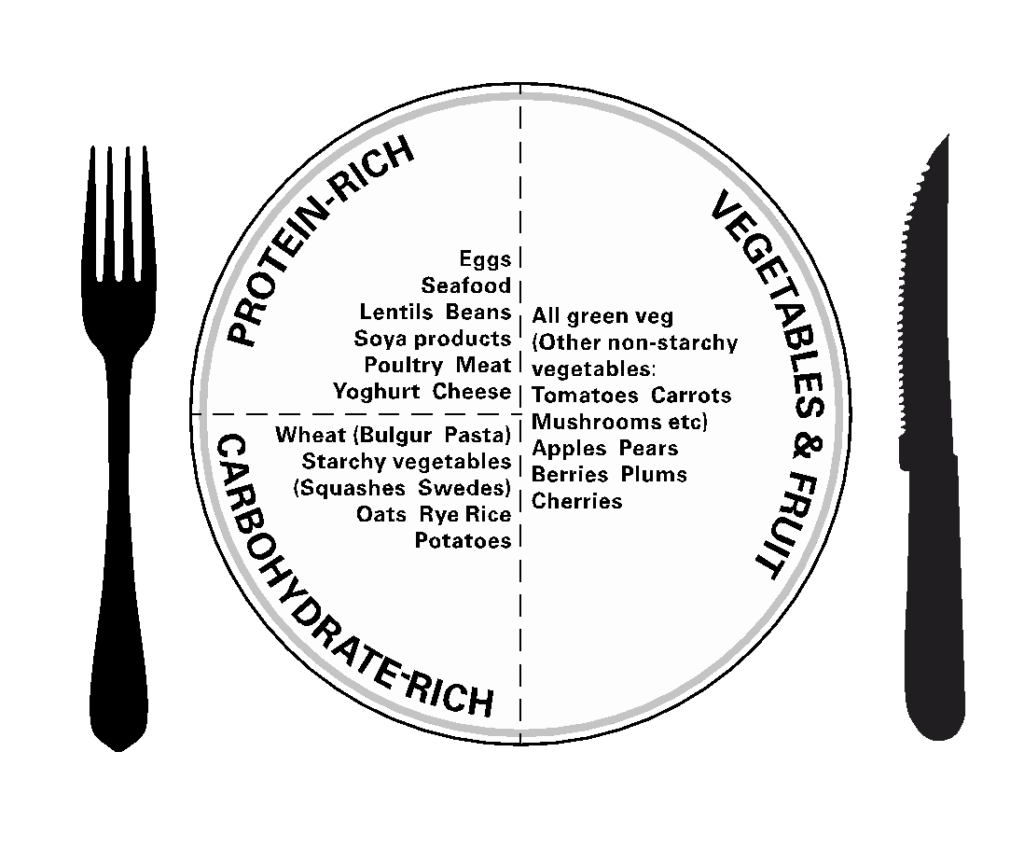
Half your plate should be vegetables and fruit. A quarter should be protein. A quarter carbohydrate.
Vegetables provide fibre, vitamins, minerals and a wide range of antioxidant and plant compounds that support metabolic and overall health.
Protein slows sugar release and provides essential building blocks. Carbohydrate portions must be modest.
Whole grains and starchy vegetables vary widely in GL. Wholemeal pasta and brown basmati rice are far better than white pasta or white rice. Swedes, carrots and squash are better than potatoes. Boiled potatoes are better than baked. French fries are the worst of all.
Beans and lentils are particularly useful in a low-GL diet because they provide both protein and carbohydrate and are rich in fibre. When combining beans or lentils with another starchy carbohydrate, consider reducing the portion of the other starch.
The amount you eat matters as much as the GI of the food. The portions below provide approximately 7 GL points, allowing you to compare typical carbohydrate foods on a like-for-like basis.
| Starchy vegetable or cereal | Portion | GL points |
|---|---|---|
| Pumpkin / squash | 1 large serving (185g) | 7 |
| Carrot | 1 large (158g) | 7 |
| Swede | 1 large serving (150g) | 7 |
| Quinoa (cooked) | 1 large serving (120g) | 7 |
| Beetroot | 1 large serving (112g) | 7 |
| Cornmeal | 1 serving (116g) | 7 |
| Pearl barley (cooked) | 1 small serving (95g) | 7 |
| Wholemeal pasta (cooked) | ½ serving (85g) | 7 |
| White pasta (cooked) | ⅓ serving (66g) | 7 |
| Brown basmati rice (cooked) | 1 small serving (70g) | 7 |
| White rice (cooked) | ⅓ serving (46g) | 7 |
| Couscous (soaked) | ⅓ serving (46g) | 7 |
| Broad beans | 1 serving (31g) | 7 |
| Sweetcorn | ½ cob (60g) | 7 |
| Boiled potato | 3 small potatoes (74g) | 7 |
| Baked potato | ½ serving (59g) | 7 |
| French fries | 1 tiny portion (47g) | 7 |
| Sweet potato | ½ serving | 7 |
GL is a useful guide, not a complete measure of how healthy a food is. Fibre, protein, fat, micronutrients, processing and overall dietary pattern also matter.
This doesn’t mean you should avoid fruit. “Whole fruit has fibre, both soluble and insoluble,” explains Lustig. “Together, they slow down glucose and fructose absorption… and they also help feed the gut bacteria. Juicing the fruit removes the protective fibre. So, eat your fruit – don’t drink it!” A glass of orange juice can contain the sugar from several oranges while providing much less fibre than the whole fruit.
A lower-GL eating pattern can form part of a broader approach to improving blood glucose regulation and metabolic health. Observational research also links healthier dietary patterns and better blood glucose control with better cognitive health, although diet alone cannot guarantee prevention of dementia.
These kinds of foods are consistent with a Mediterranean-style diet. A Finnish study compared people with a healthy versus unhealthy diet in midlife, including many of the choices above, for their risk of dementia 14 years later. Those who ate the healthiest diet had a far lower risk of developing dementia and Alzheimer’s disease [22]. It was a small study of 385 people, but it adds to a wider body of evidence linking midlife diet with later brain health.
“Those who ate the healthiest diet had an 86 to 90 per cent lower risk of dementia and a 90 to 92 per cent lower risk of Alzheimer’s disease.” – Findings from Eskelinen et al. (2011) [22]
HbA1c is a blood test that reflects your average blood glucose over the previous two to three months. It can help identify whether your blood sugar regulation is moving in the wrong direction.
In the UK, HbA1c is measured in mmol/mol [20]:
|
An HbA1c result needs to be interpreted in the appropriate clinical context. If your result is 42 mmol/mol or above, discuss it with your GP or healthcare professional.
Food for the Brain suggests below 36 mmol/mol (5.4%) as an optimal target for brain health. This is our proposed optimal target, rather than an NHS diagnostic threshold.
A low-GL diet does not mean cutting out carbohydrates or following a ketogenic diet. The brain normally relies heavily on glucose for energy, but it can also use ketones, which are produced by the liver from fat. Researchers are investigating whether ketones could help support brain energy metabolism when glucose metabolism is impaired.
Some people choose to go further with a lower-carbohydrate or ketogenic approach. Find out more in Fuel Your Brain for Better Memory and our Brain Fats domain.
If you have diabetes or take medication that affects blood sugar, speak to your GP before making significant changes to your carbohydrate intake.
A low glycaemic load (GL) diet keeps the total sugar load on your bloodstream low. It means choosing whole, fibre-rich carbohydrates such as vegetables, beans, oats and wholegrains, eating them with protein, and cutting back on sugar, white bread, white rice and fruit juice.
A diet high in sugar and refined carbohydrates can make the body resistant to insulin, the hormone that moves glucose into brain cells. That can leave the brain short of energy. Higher blood sugar, even within the normal range, has also been linked to smaller brain volume and poorer cognitive performance.
No. Whole fruit comes with fibre, which slows sugar absorption and feeds your gut bacteria. Berries, cherries and plums are especially low GL. Fruit juice is different: it has the sugar without the fibre, so eat your fruit rather than drinking it.
Food for the Brain suggests aiming for an HbA1c below 36 mmol/mol (5.4%). In the UK, 42–47 mmol/mol is classed as pre-diabetes and 48 mmol/mol or above as diabetes. If your result is raised, or you take diabetes medication, speak to your GP about the right target for you.
Glycaemic index (GI) ranks how quickly a carbohydrate food raises blood sugar. Glycaemic load (GL) also accounts for how much carbohydrate a typical serving contains, so it better reflects a meal’s real effect on your blood sugar.
Observational studies link high-GL diets and poor blood sugar control with a higher risk of cognitive decline and dementia. They show associations rather than proof of cause and effect. A low-GL diet is one part of a wider, multi-factor approach to protecting your brain, alongside the other seven domains.
Foods with a low glycaemic load (GL) include beans and lentils, nuts and seeds, non-starchy vegetables, and many whole fruits such as apples, oranges and berries. These foods generally have a smaller effect on blood glucose because they contain less available carbohydrate, or because their carbohydrate is accompanied by fibre, protein or fat. Portion size matters because glycaemic load reflects both the type and the amount of carbohydrate eaten.
Blood sugar is one part of brain health. Explore how it connects with the other seven domains.
Disclaimer: This information is for educational purposes only and is not medical advice. It does not replace consultation with a qualified health professional. If you have diabetes, take medication that affects blood sugar, or are pregnant, please talk to your GP before making significant changes to your diet.