The changes linked to memory decline don’t start the day you lose your keys. They build quietly, often over many years, and some of the most important ones show up in your blood long before they show up in your memory. That’s why blood tests for brain health are becoming an important tool for early detection. The good news? Many of these risk factors are measurable and, importantly, modifiable. Knowing your numbers gives you the opportunity to act, long before memory problems begin.
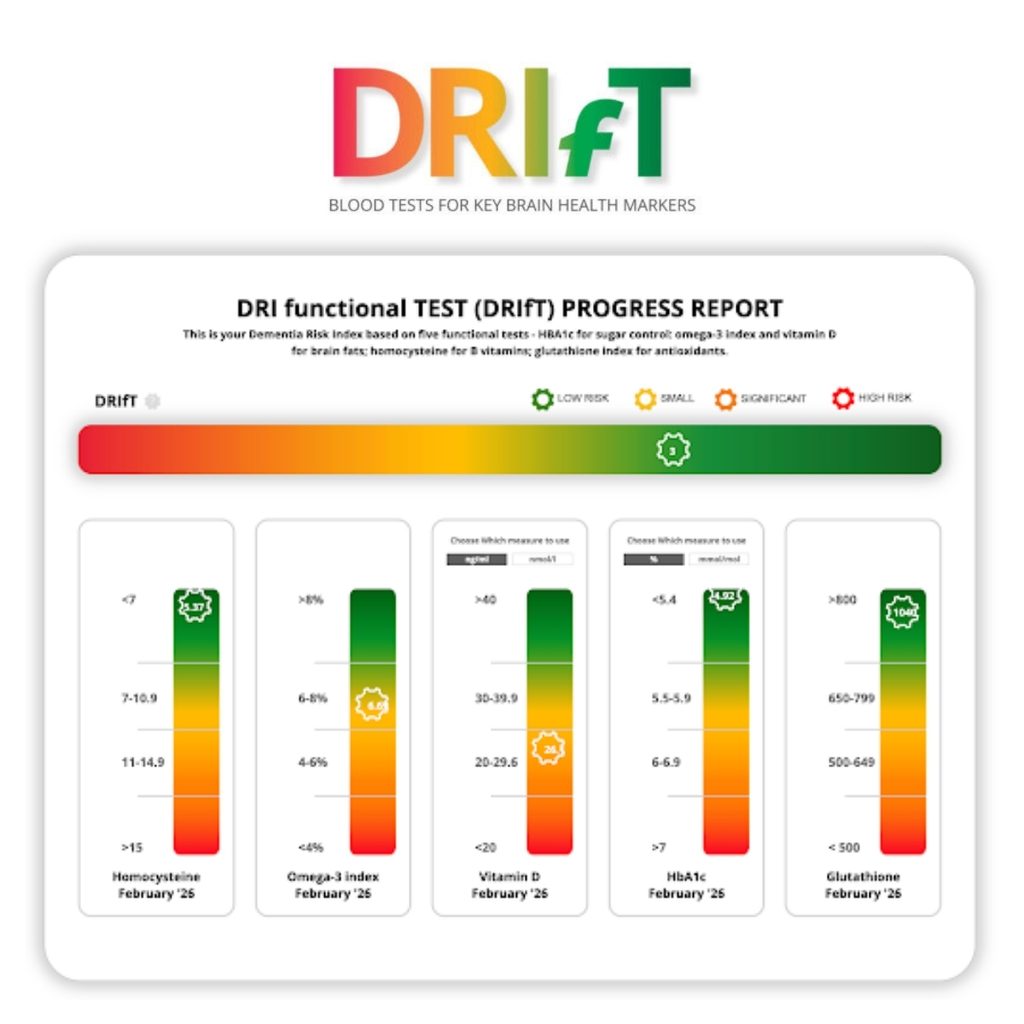
Five blood markers matter most for brain health: homocysteine, your Omega-3 Index, vitamin D, HbA1c and your glutathione index. Each one reflects a different system your brain depends on, and each one can be shifted by what you eat, how you live and, where needed, what you supplement.
This guide explains what each marker tells you, why we look at all five together rather than one at a time, and how testing at home also makes you part of our research into what really prevents cognitive decline.
You may have heard about blood tests for amyloid or p-tau, the proteins associated with Alzheimer’s. These biomarkers can help clinicians assess Alzheimer’s-related disease processes, while nutritional and metabolic biomarkers provide insights into potentially modifiable aspects of brain health (find out more here). An index built from markers you can influence is, in Patrick Holford’s words, “a lot more helpful than an amyloid or p-tau test, not least of all because you can actually do something about it.”
For a biomarker to be truly useful for brain health, it needs to do two things. First, it must predict risk. People with poor levels may be at greater risk of cognitive decline. Second, it must be modifiable. You should be able to improve it with diet, lifestyle or supplements, so that you’re acting on a cause rather than watching a consequence. The strength of evidence varies between biomarkers, but together these five markers provide valuable insights into potentially modifiable aspects of brain health. That’s why we focus on them as actionable biomarkers.
Five markers, five different insights. Each one shows something different about how well your brain is being supported, and together they show you where you stand and where to focus your efforts.
Homocysteine is an amino acid your body makes and should then recycle. That recycling (called methylation) depends on vitamins B6, B12 and folate. When you’re short of them, homocysteine builds up. Raised levels are linked to faster brain shrinkage and cognitive decline, which is why homocysteine is one of the most important, and most modifiable, risk factors we know of [1]. In a randomised trial of people with mild cognitive impairment, B vitamins that lowered homocysteine slowed the rate of brain shrinkage [2]. Most people have never heard of it, never mind measuring it. Read our homocysteine guide.
Your brain is nearly 60% fat by dry weight [3], and the omega-3 fats DHA and EPA are part of the structure of every brain cell. The Omega-3 Index measures the percentage of EPA and DHA in your red blood cell membranes, so it reflects your intake over the past few months rather than what you ate yesterday. Most people assume they get enough. A test is the only way to know. Read our guide to the Omega-3 Index and what your results mean.
Vitamin D works more like a hormone than a vitamin, and there are receptors for it throughout the body, including the brain. Low levels are common in the UK. Nearly 1 in 5 adults aged 19 to 64 (18%) is deficient, with a blood level below 25 nmol/L, and from January to March the figure rises to between 21% and 38% across age groups [4]. That cut-off is set for bone health, well below the level we aim for to support the brain, and you can’t tell from how you feel whether yours is low. It matters: in a study that followed 1,658 older adults for more than five years, those who were deficient in vitamin D were more likely to develop dementia and Alzheimer’s [5]. Read why vitamin D is your brain’s ally.
Your brain is a hungry organ and it needs a steady supply of fuel. HbA1c shows how much glucose has ‘stuck’ to your red blood cells over roughly the past three months, so it gives a long-term view of your blood sugar control rather than a one-off snapshot. Persistently high glucose can damage the brain’s blood vessels and is linked to a greater risk of cognitive decline, and you don’t need to be diabetic for raised blood sugar to matter. In a study of more than 2,000 people aged 65 and over, those without diabetes whose average blood glucose was 115 mg/dL had an 18% higher risk of dementia than those averaging 100 mg/dL, and the risk rose steadily with no safe threshold [6]. Read what the research shows on blood sugar, glycaemic load and dementia risk.
Glutathione is one of your body’s own master antioxidants. It protects cells from oxidative damage, and the brain, which burns a lot of energy and is rich in delicate fats, needs plenty of protection. Your glutathione index compares “fully loaded” glutathione with the “spent” form, so it shows how efficiently you recycle it. Think of it as a measure of antioxidant resilience. Smoking and pollution drain it; vegetables, fruit and herbs help top it up. This is the newest of the five markers, and the science behind its reference ranges is still developing. Read more about the glutathione marker.
|
Your DRIfT report places each result in one of four colour zones, from red through orange and yellow to green. The green zones represent Food for the Brain’s proposed optimal targets for brain health, based on our interpretation of the available research. These are not standard laboratory reference ranges or universally accepted clinical thresholds for dementia prevention. A result outside the green zone is not a diagnosis, but may highlight areas of nutritional or metabolic health worth exploring.
Because your brain doesn’t run on one nutrient. Testing a single marker is like checking one tyre and declaring the car roadworthy.
Patrick Holford, our founder, describes four main biological drivers of cognitive decline, which he calls the four horsemen of the mental health apocalypse. It sounds dramatic, but each one is something you can measure and, crucially, something you can change:
These systems work together. Your brain cells are built from omega-3 fats, and B vitamins help put those fats in place. Have one without the other and your brain can’t make full use of either. It’s the combination that counts.
The research supports this. When Professor David Smith and Dr Fredrik Jernerén at Oxford went back to the blood samples from their landmark VITACOG B vitamin trial, involving 168 people aged 70 and over with mild cognitive impairment, they found the B vitamins had no significant effect on brain shrinkage in people with low omega-3 levels. In those with good omega-3 levels, B vitamins slowed brain shrinkage by 40% compared with placebo, and by around 70% in those who also had raised homocysteine [7]. Researchers behind the Dutch B-PROOF trial found the same pattern when they checked their own samples. Glutathione plays a part in regulating homocysteine too. This is why looking at the bigger picture matters. You could be taking B vitamins to support your brain health, but if your omega-3 levels are low, you may not get the full benefit. It’s a powerful example of why we need a systems-based approach to preventing cognitive decline, rather than focusing on one nutrient or risk factor in isolation.
Everyone’s weak spot is different, which is another reason to test all five. When Patrick and his wife Gaby took the DRIfT test, they were eating the same food, living much the same lifestyle and taking much the same supplements. Patrick’s homocysteine was 7. Gaby’s was 15, well into the brain-shrinking zone, most likely because she wasn’t absorbing B12 well. With extra B12 and methylfolate, her level came down to 8. Without testing, neither of them would have known.
The research points the same way. A 2024 study followed 968 adults aged 50 and over from the US Framingham Offspring cohort for a median of 15.5 years. It scored each person on three markers: omega-3, homocysteine and vitamin D. Those with poor status on all three had roughly 4.7 times the risk of developing dementia of those with none [8]. The authors noted that this combined association was larger than those seen for diabetes or carrying the APOE4 gene. A French study of older adults found a similar picture when several nutrient markers were low together [9].
These are observational studies, so they show a strong association rather than proof that fixing the markers prevents dementia. But they back up what we see every day: brain health comes from a whole system working well, not from a single “magic” nutrient. That’s why the DRIfT® 5-in-1 Test combines all five markers into a single personalised score, so you can see at a glance where you’re strong and where to focus first.
Blood tests are only part of the picture. Combine your DRIfT results with the free Cognitive Function Test™, which measures how your brain is performing, and the Dementia Risk Index questionnaire, which looks at eight diet and lifestyle factors, and you get the most complete view of your brain health we can offer.
You don’t need a clinic appointment. The DRIfT 5-in-1 Test is a simple finger-prick test you do at home. You place a few drops of blood on the collection cards, post them back in the prepaid envelope, and your results appear in your personal dashboard alongside your DRIfT score.
Your results show each marker against our green zone, so you can see which areas are already in good shape and which to prioritise. You’ll get guidance on the diet, lifestyle and supplement changes that can move each marker in the right direction. Then you retest, usually after three, six or twelve months, to see what’s changed. Many people find that seeing a number improve is the best motivation there is.
Sometimes you may want to understand one area in more detail. Each DRIfT biomarker test is also available individually, giving you the flexibility to test, track or retest what matters to you (see the table above). Homocysteine is a good place to begin, because it’s common for it to be raised and it often responds well to B vitamins and diet.
The DRIfT 5-in-1 Test costs £239.60, with free UK delivery, and part of that is a donation to our research. It’s available to order in the UK, EU, USA, Canada, Australia, New Zealand, Japan, Singapore and Malaysia. Prices are shown in your local currency on the product page.
When you order a DRIfT test, you’re doing more than checking your own brain health. Food for the Brain is a small charity, and every test ordered is also a donation to our charitable research and education. You get answers for yourself, and you help us find answers for everyone. Every result feeds our ongoing research into what actually protects the brain, so you’re contributing to the evidence, not just reading about it.
Here’s how. Your results are fully anonymised and added to the COGNITION Biobank™, our growing database that brings together blood biomarkers, cognitive performance, diet and lifestyle. Around 475,000 people have now taken our Cognitive Function Test. Every Citizen Scientist who adds their blood results helps us see what people with healthy, high-scoring brains are doing differently from those whose scores are slipping, and which changes make the biggest difference. It also lets us redefine what an “optimal” level of each marker really means for the best possible cognitive health, rather than settling for what’s merely “normal“.
As Associate Professor Tommy Wood BM BCh, PhD, head of Food for the Brain’s research and a neuroscientist and physician at the University of Washington, puts it: “By tracking a person’s blood sugar, vitamin B, D and omega-3 status against changes in cognitive function over time, in addition to lifestyle factors, such as sleep and physical activity, we can learn what really helps prevent cognitive decline.”
That research is already changing things. Analysing more than 600 glutathione tests with our laboratory partners helped us refine the reference ranges for the glutathione index.
We’re also contributing to research supported by an Innovate UK grant, exploring whether our Cognitive Function Test could be useful in NHS memory clinics. Findings are expected in 2027.
As an independent charity, our research is guided by one question: what really helps people protect their brains as they age? We’re funded by people like you, and all the funds we raise, from tests and from FRIENDS, go back into research, education and reaching more people. So whether you test, retest or become a FRIEND of Food for the Brain, you’re helping to build the evidence on what can prevent cognitive decline.
You can’t change what you don’t measure. Five markers, one finger-prick, and a clear picture of what your brain needs from you. And every result you share helps us find out what really prevents cognitive decline, for you and for everyone who comes after you.