
Homocysteine is a natural amino acid produced during a vital process in the body called methylation. It is fast becoming one of the most important biomarkers of long term health, and understanding lowering homocysteine is becoming equally important.
Methylation is a fundamental biochemical process happening in every cell, every second. It helps switch genes on and off, build and regulate neurotransmitters, repair DNA, support detoxification, and maintain healthy blood vessels. For methylation to run smoothly, the body depends on key nutrients, particularly B vitamins.
Homocysteine sits at the centre of this process. When methylation is working well, homocysteine is efficiently recycled and kept within a healthy range. When it rises, it reflects strain within the methylation cycle.
This matters because disrupted methylation affects brain chemistry, vascular integrity, and cellular repair. It is a systems issue, not a single pathway problem.
Despite this, homocysteine is rarely discussed in routine healthcare, and access to accurate, affordable testing has historically been limited. Yet the research is extensive. Elevated homocysteine has been linked to more than 100 health conditions, including cardiovascular disease, depression, and neurodevelopmental delays in children (1, 2, 3).
Levels above approximately 10 µmol/L are considered a red flag. This is not uncommon. Studies in the United States suggest that around 40% of adults over 60 have levels above 11 µmol/L (4). In the UK, nearly 40% of older adults are thought to have low vitamin B12 status, which is associated with accelerated brain shrinkage (5).
Learn more about homocysteine testing.
Before trying to lower homocysteine, it’s important to understand whether your level is actually elevated. If you’ve already been tested, read our guide to Homocysteine Levels Explained to help interpret your result.
Quick Answer: How to Lower Homocysteine
The most effective ways to lower homocysteine are to optimise vitamin B12, folate, vitamin B6 and riboflavin status, improve diet quality, address underlying health conditions, and monitor progress through testing.
Ways to Lower Homocysteine
B vitamins are essential for breaking down homocysteine through the methylation cycle.
– Folate from leafy green vegetables and legumes
– Vitamin B12 from animal foods or supplementation
– Vitamin B6 from whole foods such as poultry, fish and bananas
These nutrients are the most important dietary factors for lowering homocysteine.
A balanced, nutrient-rich diet supports efficient metabolism.
Focus on:
– whole foods
– vegetables and fruits
– healthy fats (especially omega-3s)
– adequate protein
Excess alcohol can interfere with B vitamin metabolism and raise homocysteine levels.
– limit intake where possible
– ensure adequate nutrient intake if consuming alcohol
Poor sleep and chronic stress can affect metabolic processes, including methylation.
– aim for consistent, high-quality sleep
– manage stress through lifestyle practices (e.g. exercise, relaxation)
In some cases, supplementation may help support optimal levels.
This may include:
– folate (often as methylfolate)
– vitamin B12
– vitamin B6
Supplementation should ideally be guided by testing and individual needs.
More information: Eight Natural Ways to Lower Your Homocysteine
So how much does this biomarker really matter? At Food for the Brain, we follow the evidence, and the research linking elevated homocysteine to long-term health outcomes is extensive. High levels have been associated with cardiovascular disease, cognitive decline, pregnancy complications, and a broad range of neurological and mental health conditions.
Elevated homocysteine is associated with damage to the inner lining of blood vessels, promoting atherosclerosis. One study found that people with levels above 20 µmol/L had nearly five times the risk of death, with risk increasing by around one-third for every 5 µmol/L increase (6). Another large study involving cardiovascular patients found a threefold higher risk of death in those with the highest homocysteine levels compared to the lowest (7).
High homocysteine has been linked to accelerated brain shrinkage and increased p-tau accumulation, a protein strongly associated with Alzheimer’s disease (8). Research also suggests that lowering homocysteine with targeted B vitamins may help slow brain atrophy and cognitive decline (1).
Even modest elevations in homocysteine during pregnancy, particularly above 9 µmol/L, have been associated with increased risk of miscarriage and developmental challenges in children, including anxiety, social difficulties, and withdrawn behaviour later in life (9, 10, 11).
Elevated homocysteine has been associated with a wide range of psychiatric and neurological conditions, including depression, autism, bipolar disorder, schizophrenia, migraines, dementia, obsessive-compulsive disorder, and multiple sclerosis. These associations likely reflect the central role methylation plays in brain chemistry, neurotransmitter production, and neurological resilience.
For a deeper look at the science, mechanisms, and research behind these associations, read our extensive guide to homocysteine and brain health.
Homocysteine rises when the methylation cycle becomes less efficient. This may occur because of inadequate intake of folate, vitamin B12, vitamin B6 or riboflavin, genetic factors affecting methylation, ageing, certain medications, smoking, excess alcohol intake, or underlying health conditions.
Read more in our guide to What Causes High Homocysteine.
Homocysteine is recycled through the methylation cycle.
The body uses this process to activate nutrients and manage many chemical reactions every day.
For example, folate (and folic acid, its synthetic form) needs to change into its active form, methylfolate. This change helps support cellular functions. Key enzymes that aid in methylation depend on vitamins B6, B12, and folate. They also need cofactors like zinc, riboflavin (B2), niacin (B3), and trimethylglycine (TMG).
When this system is under-resourced or less efficient, homocysteine levels go up. This can happen with age or certain diets like veganism (3). Homocysteine can act as a “functional” marker of methylation efficiency, a bit like HbA1c reflects longer-term blood glucose control.
Learn more in our complete guide to Methylation and Homocysteine.
The encouraging news is that there is a lot you can do to lower homocysteine levels!
The simplest and most effective way to lower homocysteine is often through targeted B vitamin support. See our homocysteine supplementation guide with recommended B vitamin doses and brands.
Most critical is the amount of vitamin B12 they provide.
The basic Dietary Reference Value that you see on supplements is 2.5mcg. Few provide more than 10mcg, which is sufficient if you don’t have raised Hcy. Standard low-dose supplements are unlikely to significantly reduce an elevated homocysteine level. Professors Smith and Refsum recommend 500mcg a day – substantially higher than standard reference intakes. This is both safe and effective especially if taken alongside B6 (20mg) and methylfolate (400mcg). Also, it doesn’t take long to bring your level down.
In addition to these core nutrients, extra support from zinc, TMG (trimethylglycine), and N-acetyl cysteine (NAC) may be beneficial. NAC, for instance, may help channel homocysteine toward SAMe production by boosting the body’s antioxidant defences and glutathione production (1).
Many of the nutrients required for healthy methylation are found naturally in whole foods. Leafy green vegetables provide folate, while seafood, eggs and dairy products provide vitamin B12. Nuts, seeds and legumes contribute additional nutrients that support healthy homocysteine metabolism.
For a detailed breakdown of folate, vitamin B12, vitamin B6, riboflavin, choline and betaine food sources, see our guide to the best foods to lower homocysteine.
For people with elevated homocysteine, targeted supplementation with vitamin B12, methylfolate and vitamin B6 is often the most effective intervention. Additional support from riboflavin, zinc, TMG and NAC may also be beneficial.
Read our Homocysteine Supplementation Guide.
Most people can lower elevated homocysteine within weeks to a few months, depending on the underlying cause and the effectiveness of the intervention. Improvements are often seen after correcting vitamin B12, folate or vitamin B6 deficiencies.
Possibly. Having a level below 4 is rare in and of itself. Even rarer is for someone to have a level below 4 and a problem. Why could too low be a problem? The second part of the story is that homocysteine can be turned into glutathione, the master antioxidant via the ‘sulphuration’ pathway, through the interaction of B vitamins on homocysteine in the presence of glycine (a sulphur container amino acid). This involves an enzyme, CBS (cystathionine beta synthase) which is dependent on vitamin B6.
Theoretically, if there wasn’t enough homocysteine, then this pathway for making glutathione would be in short supply. Such a finding has been shown in some children with autism, but it is very rare. And how would you know that the very low homocysteine, below 4 mcmol/l, was a bad thing, leading to less glutathione? I’d test the person’s glutathione or, more accurately, their Glutathione Index. Think of glutathione as the good guy, made from recycling rubbish, and homocysteine as the bad guy.
If both were low I’d be thinking ‘where is the log jam’? You can see in the diagram above that the cheap, stable, inexpensive folic acid should turn into TH Folate, then, via the action of the MTHFReductase enzyme, into 5-methylfolate, or reduced, fully loaded folate, used in the body and brain in a thousand ways. But we must also note that CBS enzyme, dependent on vitamin B6 (itself dependent on zinc to be ‘activated’) must be fully functional. This pathway, if working properly, would naturally create glutathione, the body and brain’s master antioxidant.
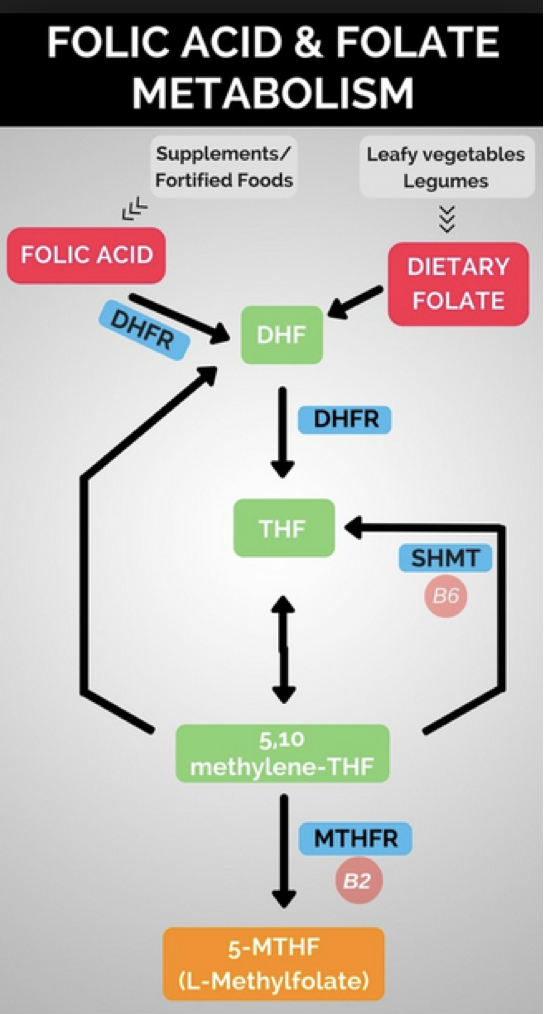
If this pathway is not working effectively, and both homocysteine and Glutathione are low, I’d suspect two ‘faulty’ enzymes. That is either the enzyme DHFR that does the first step in activating folic acid or MTHFR, which does the second step. This is dependent on vitamin B2 (riboflavin).
Enzymes are built from a genetic blueprint. If you inherit a slightly dodgy blueprint, your enzyme factory turns out cheap goods. You might then need a little help from riboflavin (B2) for those who inherited the gene MTHFR677T or TT. We all need B2, but this enzyme won’t work nearly so well if you’re deficient and have this genetic ‘polymorphism’. That is why having MTHFR677T or TT, which is present in about 24% of people (10% in Africans, 34% of Europeans) puts up a person’s risk for Alzheimer’s. But, in studies giving the three main co-factor nutrients – B6, folic acid and B12 – it makes no difference whether or not you have this dodgy gene. Homocysteine still gets lowered. That’s right. Folic acid works, both in combination, and on its own, in lowering high homocysteine and is turned into the activated form methylfolate without a problem. So that suspected enzyme variation, especially if you have enough B12, is not looking so critical. In all studies I’ve seen, where B6, B12 and folic acid is given, the beneficial effect is the same in both those with or without this gene ‘defect’.
Because elevated homocysteine rarely causes symptoms, testing is often the only way to identify a problem. A homocysteine blood test can help assess methylation efficiency and identify potential nutritional imbalances before more serious health consequences develop.
Learn more about Homocysteine Testing.
Frequently Asked Questions
The fastest way to lower homocysteine is to identify and address the underlying cause. For many people, increasing intake of folate, vitamin B12 and vitamin B6 through diet or supplementation can significantly reduce homocysteine levels within a few weeks. Regular testing can help track progress and ensure that levels are moving in the right direction.
The most important vitamins for lowering homocysteine are folate (vitamin B9), vitamin B12, vitamin B6 and riboflavin (vitamin B2). These nutrients play a key role in the methylation cycle, which helps convert homocysteine into other beneficial compounds used by the body.
Foods rich in folate, vitamin B12 and vitamin B6 may help lower homocysteine levels. Good sources include leafy green vegetables, beans, lentils, eggs, fish, seafood, poultry and dairy products. A balanced diet rich in whole foods provides many of the nutrients needed for healthy homocysteine metabolism.
With appropriate dietary and lifestyle changes, homocysteine levels can often improve within a few weeks to a few months, depending on the underlying cause and consistency of intervention.
Laboratory reference ranges vary, but homocysteine levels above 15 µmol/L are generally considered elevated. However, some researchers believe that levels above 10 µmol/L may already be associated with increased health risks.
In most cases, yes. Homocysteine is a responsive biomarker, and targeted dietary and lifestyle changes can often improve it.
Optimising the intake and absorption of key nutrients, particularly folate, vitamin B12 and vitamin B6, is central to this process. Adequate omega-3 fats, especially DHA, also play an important role in supporting brain health.
Alongside nutrition, reducing alcohol intake, improving overall diet quality, supporting gut health and managing stress can all help bring levels back into a healthier range.
For those who want more structured support, we guide people through these steps in our 6-month COGNITION brain upgrade programme, available free when you become a FRIEND of Food for the Brain.
Join our research and order your homocysteine test to understand your body and take action toward lowering homocysteine effectively.
You can test your homocysteine in a single test or as part of our DRIfT 5 in 1 which also tests Vitamin D, HbA1c, Omega-3 status and Glutathione.
Food for the Brain is a not-for-profit educational and research charity that offers a free Cognitive Function Test and assesses your Dementia Risk Index to be able to advise you on how to dementia-proof your diet and lifestyle.
By completing the Cognitive Function Test you are joining our grassroots research initiative to find out what really works for preventing cognitive decline. We share our ongoing research results with you to help you make brain-friendly choices.
Please support our research by becoming a Friend of Food for the Brain.