
Description
What You Get With Your Homocysteine Test:
Your test includes everything needed to collect your blood sample at home and return it for analysis. Once your sample has been processed, you will receive your homocysteine result so you can see whether your level is within the expected range or warrants further attention.
If your level is elevated, you can use our Homocysteine Levels Explained guide to understand your result and our guide to lowering homocysteine to explore the factors that may be contributing.
What Does the Homocysteine Test Kit Contain?
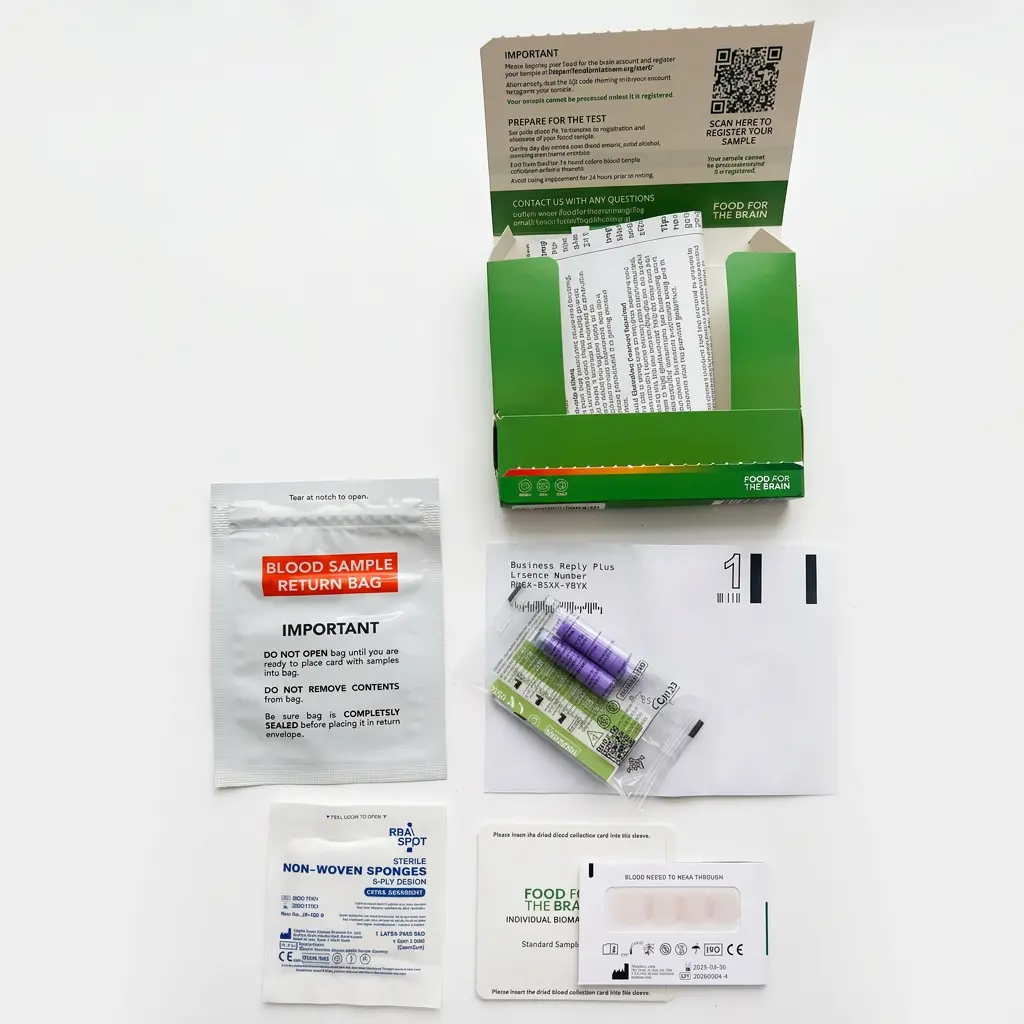
Your at-home homocysteine test kit contains the materials needed to collect your blood sample at home.
The kit contains:
- 2 single-use lancets for collecting your finger-prick blood sample
- Blood spot collection card for collecting your sample
- Alcohol swab for cleaning your finger before collection
- Gauze pad for use after collecting your sample
- Adhesive bandage
Follow the instructions supplied with your test carefully when preparing for the test, collecting your sample and returning it for analysis.
Why Test Your Homocysteine?
Homocysteine is produced naturally when your body metabolises methionine, an amino acid found in dietary protein.
Normally, homocysteine is continually recycled or converted into other compounds through metabolic pathways that depend on nutrients including folate, vitamin B12 and vitamin B6. When these pathways are not working efficiently, homocysteine can accumulate in the blood.
Your homocysteine level can also be influenced by factors including age, kidney function, smoking, alcohol consumption, certain medicines and genetic differences.
Importantly, you cannot reliably predict your homocysteine level simply from your diet, symptoms or lifestyle. Someone who appears to eat a healthy diet can still have an elevated level, while elevated homocysteine itself may cause no obvious symptoms.
A blood test is therefore needed to establish your actual homocysteine level.
For a deeper explanation of the science and health research, read what homocysteine is and why it matters.
How the At-Home Homocysteine Test Works
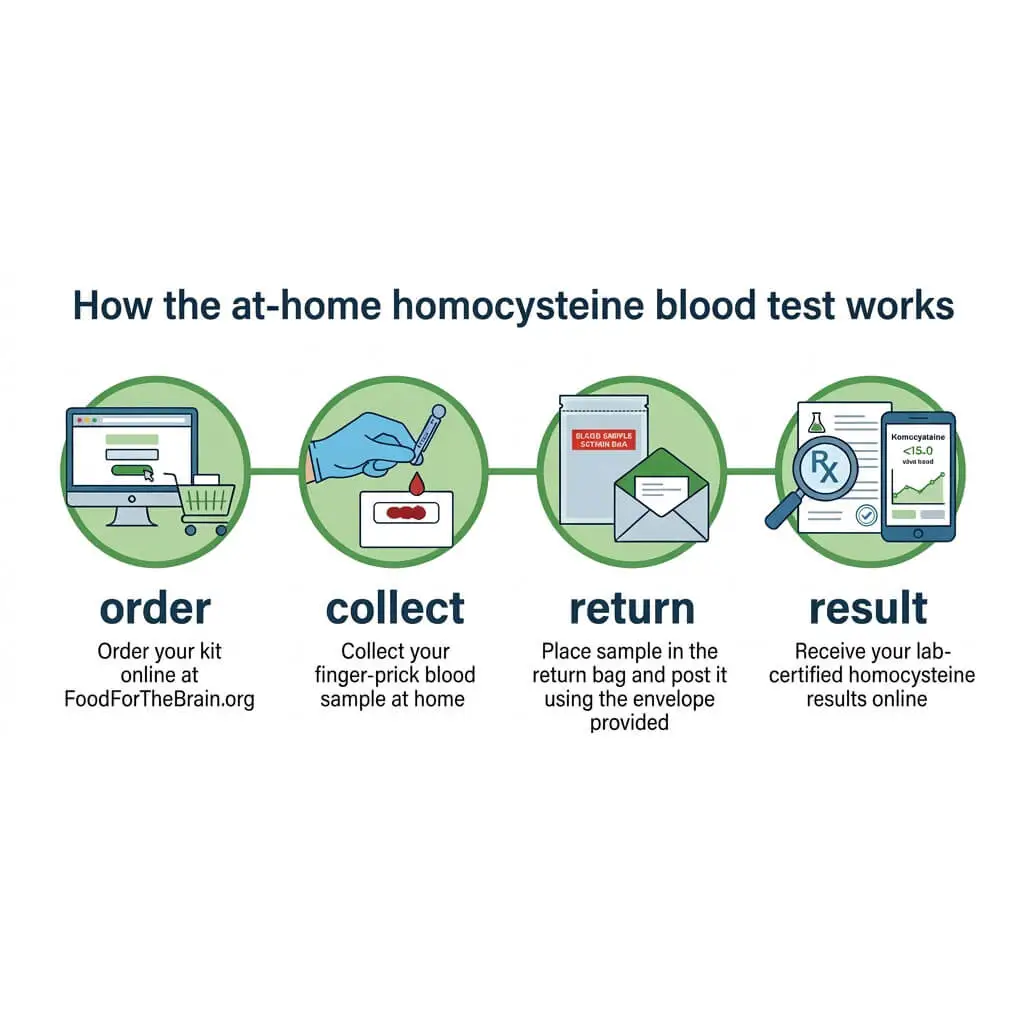
The Food for the Brain Homocysteine Test uses a small finger-prick blood sample that you collect at home and return for laboratory analysis.
1. Order Your Test
Order your homocysteine test online and your test kit will be sent to you with the materials and instructions required to collect your sample.
2. Collect Your Sample at Home
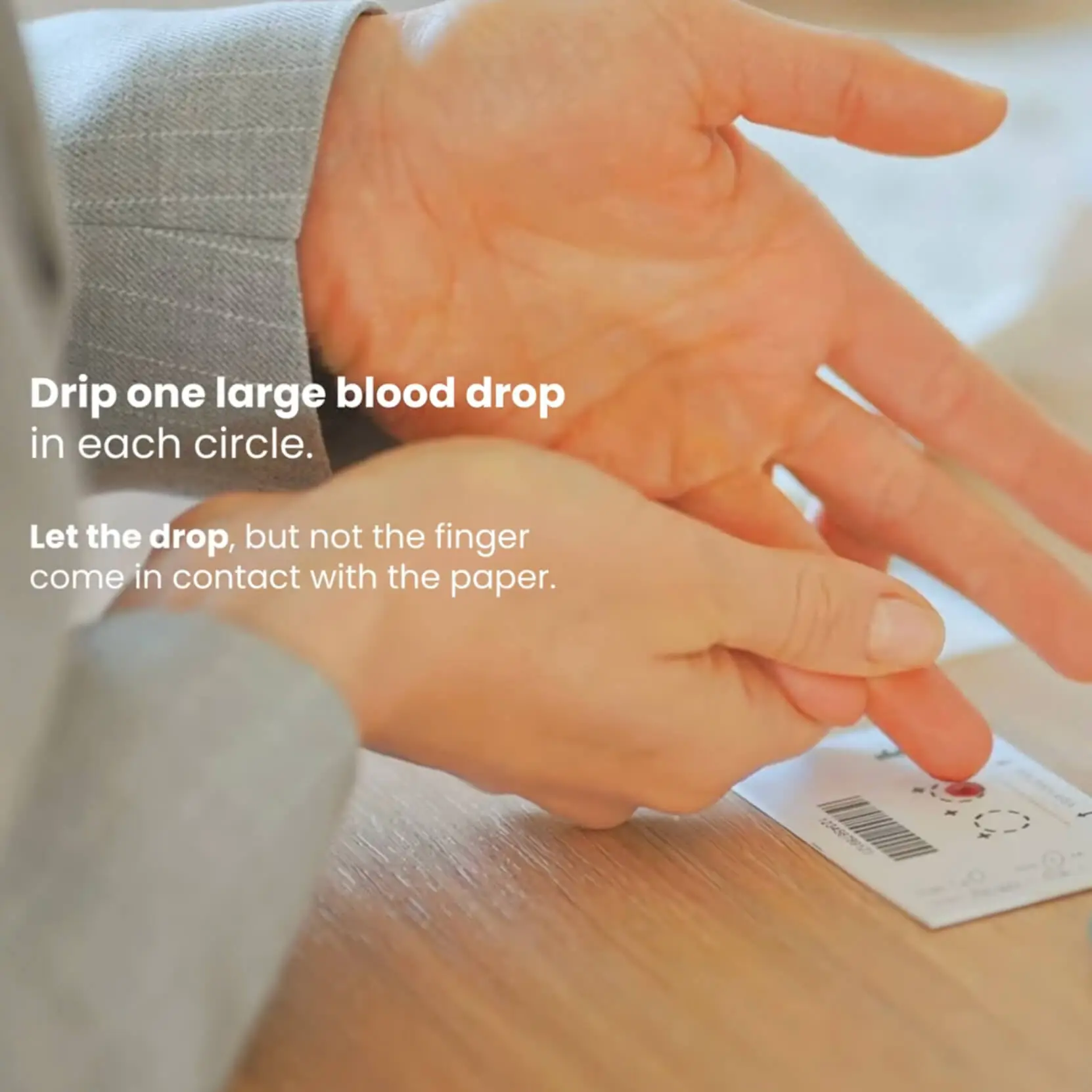
Follow the supplied instructions to collect a small finger-prick blood sample onto the blood spot collection card.
It is important to follow the collection instructions carefully so that there is sufficient sample for laboratory analysis.
3. Return Your Sample
Once you have collected your sample, follow the supplied instructions for returning it for analysis.
The test uses a dried blood spot sample, meaning that your blood is collected onto a specialist sample card rather than into a conventional blood collection tube.
4. Laboratory Analysis
Your sample is analysed to determine your homocysteine concentration.
5. Receive Your Homocysteine Result
Your result is reported in µmol/L, allowing you to see your measured homocysteine level and consider whether further attention may be warranted.
For detailed information about preparation, who may benefit from testing and the science behind homocysteine measurement, read our complete guide to homocysteine testing.
Is the At-Home Homocysteine Test Accurate?
An important consideration with any at-home blood test is whether the collection and laboratory method can provide a reliable measurement.
Homocysteine presents a particular challenge with conventional blood testing because homocysteine can continue to be released from blood cells after a venous sample has been collected. Conventional samples therefore need to be handled and processed appropriately.
The Food for the Brain test uses a dried blood spot sample analysed using LC-MS (liquid chromatography-mass spectrometry).
This provides a practical way to measure homocysteine from a sample collected at home while avoiding some of the rapid processing requirements associated with conventional venous homocysteine samples.
For more information about the testing method, scientific validation and factors that can affect a result, read our complete guide to homocysteine testing.
What Will My Homocysteine Test Result Mean?
Your homocysteine result is reported in micromoles per litre (µmol/L).
Laboratory reference ranges vary. At Food for the Brain, we consider a homocysteine level of around 7 µmol/L to be optimal. Levels above 10 µmol/L warrant attention and consideration of the factors that may be contributing to the result.
A result above this level is not, by itself, a diagnosis of a disease or health condition. Homocysteine needs to be considered in the context of your nutritional status, age, health, lifestyle and other relevant factors.
If you already have a result, see Homocysteine Levels Explained: What Your Results Mean for a detailed guide to different homocysteine levels and what to consider next.
If your homocysteine is elevated, our guide to lowering homocysteine explains the dietary, nutritional and lifestyle factors that may help and the possible underlying factors to consider.
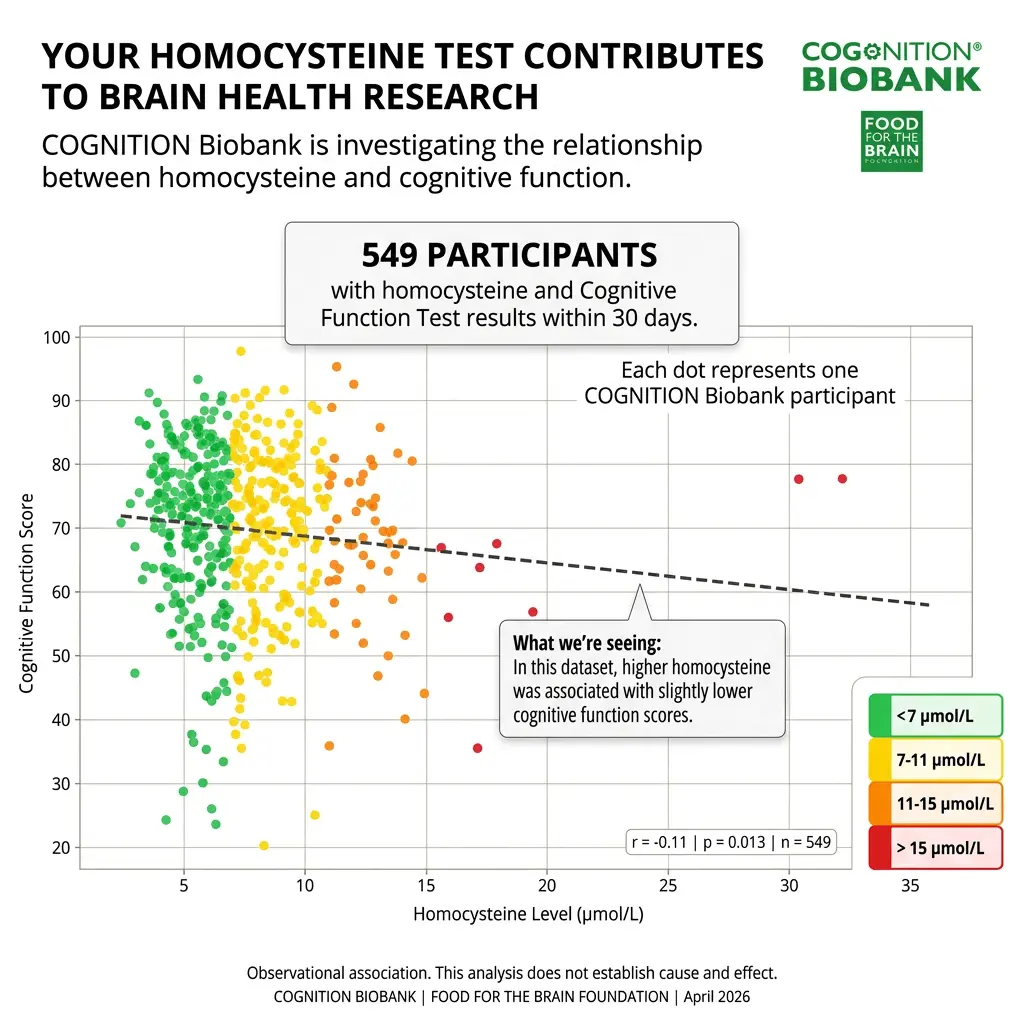
Your Homocysteine Test Supports Brain Health Research
Food for the Brain is a registered charity working to understand how nutrition and lifestyle influence cognitive health.
Our homocysteine testing programme forms part of our wider citizen science research. By participating, you can contribute to the COGNITION Biobank, helping us investigate relationships between homocysteine, nutrition, lifestyle and cognitive health across a wider population.
Your own result provides information about your homocysteine level, while your participation can also contribute to research designed to improve our understanding of nutrition and brain health.
For detailed information about fasting, supplements, medicines and preparing to collect your sample, see our homocysteine test FAQs.