
Applying Research Archives - Food for the Brain

because prevention is better than cure.

because prevention is better than cure.

Mini Cart 0

Your cart is empty.

Mini Cart 0

Your cart is empty.

New Study: Is Red Meat Bad for Your Brain?

New Study: Is Red Meat Bad for Your Brain?

New Study: Is Red Meat Bad for Your Brain?

In a culture where the average plate still leans heavily towards meat – often processed, often excessive – it’s time to reassess the impact of our protein choices not just on our waistlines, but on our brains. A recent study in Neurology (2025) has added fresh weight to decades of evidence linking red and processed meat consumption to an increased risk of dementia and cognitive decline (1). Meanwhile, fish – particularly oily fish – continues to top the charts as the most protective food for your brain (2,3).

So, what does this mean practically for those of us trying to upgrade our brains and reduce our risk of cognitive decline? The answer may be as simple as this: eat more fish and fewer sausages.

Red Meat, Processed Meat and the Rising Risk to Brain Health

A new US cohort study, which followed over 77,000 adults across 30 years, found that:

  • Processed red meats (bacon, hot dogs, sausages, salami, bologna and other processed meat products) were clearly problematic. Consuming just 0.25 servings per day or more was associated with a 13% higher risk of developing dementia compared with those eating less than 0.1 serving (1).
  • Unprocessed red meat (e.g. beef or lamb) was linked to a 16% increased risk of subjective cognitive decline – that is people reporting that their memory or mental sharpness was worsening – when consuming more than one serving daily compared to less than half a serving per day. However, the researchers noted that this link did not reach statistical significance for diagnosed dementia overall (1).
  • More encouragingly, replacing one daily serving of processed red meat with a serving of nuts, lentils, or beans was associated with a 19% lower risk of dementia (1).

These findings are consistent with a large UK Biobank analysis of almost half a million adults, which found that each additional 25 g/day of processed meat (bacon, ham, sausages, meat pies, kebabs, burgers, chicken nuggets) was associated with a 44% higher risk of all-cause dementia and a 52% higher risk of Alzheimer’s disease. In contrast, each 50 g/day of unprocessed red meat was linked to a 19% lower risk of all-cause dementia and a 30% lower risk of Alzheimer’s disease (4).  This reinforces the idea that it is the processing – not necessarily the meat itself – that may be most harmful.

These associations were observed regardless of whether participants carried the APOE ε4 gene variant – further evidence that dietary choices have a significant impact and that Alzheimer’s is ‘not in the genes’. (4).

The Global Pattern

The irrelevance of genetics in these findings is further supported by global evidence. An ecological analysis across 204 countries found that higher national per-capita total meat supply – including both red and white meats – was significantly associated with higher dementia incidence, even after adjusting for ageing, economic development and genetic risk, including APOE ε4 prevalence where available (5). In other words, the meat-dementia link is not confined to particular genetic subgroups but is observable across populations worldwide, suggesting that the way we produce and consume meat may be influencing brain health trends on a global scale. 

What we put on our plate is powerful when it comes to reducing dementia risk – more so than any genetic variations that attract attention in the media.

Why Fish is Brain Food

The answer is not to go hungry, but to swap for something else – and when it comes to brain health, marine foods are your answer.

Unlike red meat, fish – especially oily varieties like salmon, sardines or mackerel – continue to show a strong protective effect.

A comprehensive 2024 meta-analysis found that:

  • Eating one to two servings of fish per day (roughly 150 g) is associated with a 20% reduced risk of Alzheimer’s disease and up to 30% slower cognitive decline (2).
  • Another study found that people who ate fish at least once a week had a one-third lower risk of Alzheimer’s compared with those eating fish less than weekly (3).

Why? Omega-3 fats, especially DHA, are critical for brain function and structure. They reduce inflammation, support synaptic plasticity and help clear beta-amyloid – a protein associated with Alzheimer’s disease.

As explained in the COGNITION™ 6-month programme, omega-3 fats from fish oil play a pivotal role in building and repairing the brain, particularly in mid-life, when early signs of cognitive decline can start to emerge.

That’s why we offer omega-3 at-home blood tests – so you can check whether you’re getting enough through your diet or if it’s time to add a supplement. You can test omega-3 on its own here, or as part of our 5-in-1 DRIfT test where you can also check your homocysteine and glutathione status at the same time.

A Simple Swap with Profound Impact

From a cognitive health perspective, the data is now hard to ignore: if you’re regularly eating red or processed meat – especially more than once a day – your brain may be paying the price. But shifting even one of those servings towards fish, eggs or plant-based proteins could make a meaningful difference.

Interestingly, the main culprit in the latest studies was processed meat. This supports a key principle in brain-friendly eating: most natural whole foods – whether meat, fish, fruit, nuts, legumes, wholegrains or dairy – are not the problem. It’s when we distort them into ultra-processed, factory-made food that health is undermined.

This isn’t about becoming vegan or pescatarian. It’s simply more evidence to reduce processed foods and ensure optimal omega-3 intake. 

So next time you’re at the supermarket make a cow happy and buy a fish.

Resources:

Order your omega-3 test today to find out if you are eating enough of these essential fatty acids. You can test omega-3 on its own here, or as part of our 5-in-1 DRIfT test. Available globally.

References:

You J, Zhang L, Zhou Y, et al. Total meat supply and incidence of dementia: an ecological study of 204 countries. Front Public Health. 2025;13:1589936. doi:10.3389/fpubh.2025.1589936.

Li Y, Li Y, Gu X, Liu Y, Dong D, Kang JH, Wang M, Eliassen H, Willett WC, Stampfer MJ, Wang D. Long-Term Intake of Red Meat in Relation to Dementia Risk and Cognitive Function in US Adults. Neurology. 2025;104(3):e210286. doi:10.1212/WNL.0000000000210286.

Godos J, Micek A, Currenti W, Franchi C, Poli A, Battino M, Dolci A, Ricci C, Ungvari Z, Grosso G. Fish consumption, cognitive impairment and dementia: an updated dose-response meta-analysis of observational studies. Aging Clin Exp Res. 2024;36(1):171-182. doi:10.1007/s40520-024-02823-6.

Beydoun MA, Beydoun HA, Gamaldo AA, Teel A, Zonderman AB, Wang Y. Epidemiologic studies of modifiable factors associated with cognition and dementia: systematic review and meta-analysis. BMC Public Health. 2014;14:643. doi:10.1186/1471-2458-14-643.

Zhang Z, He P, Liu M, et al. Meat consumption and risk of incident dementia: cohort study of UK Biobank participants. Am J Clin Nutr. 2021;113(5):1228-1236. doi:10.1093/ajcn/nqaa343.
Further info

Groundbreaking New Research: The Key to Reducing Dementia Risk

by Cath Verner

A landmark study from the Centre for Healthy Brain Ageing (CHeBA) at the University of New South Wales (Sydney, Australia) has provided compelling evidence that targeted diet and lifestyle changes can improve cognitive function in older adults. 

Or put simply, what we teach and promote at Food for the Brain works when it comes to promoting brain health.

Raising awareness and providing tools to support the critical role of diet and lifestyle in long-term cognitive health is both essential and part of the solution.

This recent study affirms our approach: sustained step-by-step adjustments to diet, exercise, sleep, and social engagement significantly reduces the risk of dementia as well as maintaining – and even enhancing – cognitive function.

Study shows a holistic approach to brain health works

The CHeBA study recruited over 6000 adults aged 55 to 77, dividing them into two groups, one participating in an online lifestyle intervention programme and the other serving as a control group.

  • Physical activity (strength and balance training), 
  • Brain training (three weekly cognitive training sessions), 
  • Mediterranean diet (rich in plant foods and healthy fats with limited meat and dairy), 
  • Mental well-being (a digital anxiety and depression reduction program).

While both groups showed some cognitive improvements, those in the intervention group experienced significantly greater gains, demonstrating the added value of a structured, multi-domain approach.

Professor Brodaty, one of the study’s research team, stated:

“Participants aged 55-65 showed greater improvement than those aged 66-77, suggesting that prevention programmes should start earlier.”

Why a Multi-Domain Approach Works!

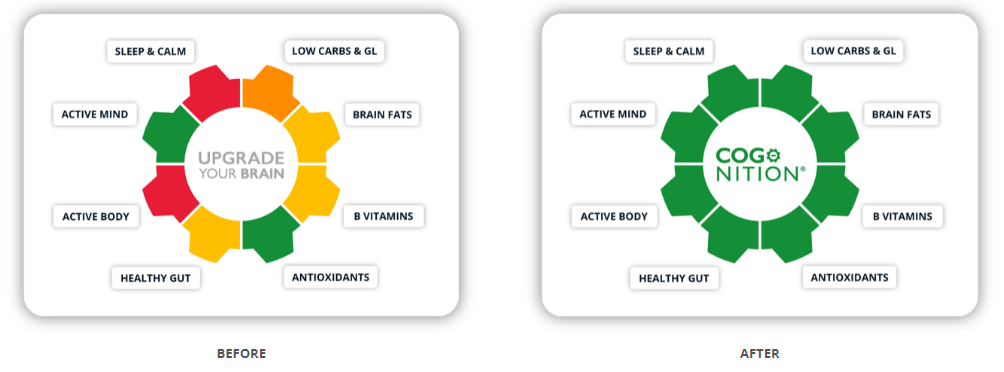
Unlike traditional approaches that focus on just one or two factors, the COGNITION® Programme, which you get access to when you become a FRIEND of Food for the Brain, is similarly built on eight interwoven pillars—including diet, physical exercise, sleep, social involvement, and even the gut microbiome—to provide a comprehensive brain health plan.

The study’s ‘Maintain Your Brain’ trial further supports this, showing that targeting multiple lifestyle domains simultaneously – including physical activity, nutrition, brain training, and mental well-being – leads to greater cognitive benefits, rather than focusing on a single risk factor.

And, as we always say, the earlier you start, the better!

Before and after images of the Cognition cog.
Your Roadmap to the 8 Pillars of Cognitive Health

In line with this study, we focus on 8 key domains that influence brain health. These areas provide strategies to help individuals reduce their risk of cognitive decline and support long-term brain health:

Domain 1: Low Glycemic Load (GL) Diet – Managing blood sugar levels is crucial for brain function. High-sugar diets contribute to inflammation and insulin resistance, impairing cognitive performance. A low-GL diet helps stabilise energy levels and protects brain cells from damage

Domain 2: B Vitamins & Homocysteine Levels – High homocysteine levels, a by-product of metabolism, are linked to cognitive decline. Ensuring adequate B vitamins (B6, B12, and folate) supports brain function and lowers homocysteine levels.

Domain 3: Brain-Boosting Fats – Healthy fats like omega-3s (found in fish, flaxseeds, and walnuts) are essential for brain cell structure and function. They help reduce inflammation, enhance memory, and support cognition.

Domain 4: Antioxidants & Polyphenols – Free radicals damage brain cells, but antioxidants (from colourful fruits, vegetables, green tea, and dark chocolate) help combat oxidative stress and keep your brain young.

Domain 5: Healthy Gut & Microbiome – The gut-brain connection is vital for mental clarity and mood. A diverse microbiome (supported by fibre-rich foods, fermented foods, and probiotics) can reduce inflammation and improve neurotransmitter function, supporting memory and mental health.

Domain 6: Active Body (Exercise & Movement) – Regular physical activity boosts blood flow to the brain, supports neuroplasticity, and reduces the risk of dementia. Both aerobic exercise (like walking and cycling) and strength training play a role in maintaining cognitive health.

Domain 7: Active Mind – The brain thrives on challenge! Lifelong learning, problem-solving activities, and hobbies stimulate new neural connections and help build cognitive resilience.

Domain 8: Sleep & Stress Resilience Management – Poor sleep and chronic stress are major contributors to cognitive decline. Deep, restorative sleep allows the brain to clear toxins, while mindfulness, relaxation techniques, and breathing exercises help reduce stress hormones that damage brain cells.

__

We know that these 8 domains can help you protect your brain and prevent cognitive decline – but most of us need support, accountability, motivation and structure to be able to implement the necessary changes consistently.

That is why the  COGNITION® Programme exists.

It’s designed to make implementing the above easier and simpler, one step at a time. By providing tailored advice and guidance on all eight areas, the programme offers tangible, practical steps that members can take to enhance brain function, reduce dementia risk, and improve overall cognitive well-being.

Real-Life Results…

As a research charity with a stellar scientific advisory board, we care about excellent research being carried out. 

Yet the most important thing is that ‘the science’ helps to transform lives, families and communities. Citizen science in action!

Here is what can happen when you join COGNITION. One participant told us:

“I have taken the CFT for at least seven years now and find it very worthwhile.
By monitoring sensibly what I eat, as you advise and exercising within my limitations, I have found that despite being 84, my results have improved.”

This experience is echoed by another participant who found benefit in making small, sustainable lifestyle changes every day:

I’ve taken on board your recommendations and I’ve increased my vitamin B intake and started doing puzzle books every day to keep my brain active in different ways from before. I also do more exercise and yoga daily. I love the fact that I can make these small changes myself and hopefully reduce my chances of getting dementia.”

Another participant shared how working with Food for the Brain and starting with the COGNITION® Programme was a wake-up call that led to lasting changes:

Since starting with Food for the Brain, I’ve completely reshaped my lifestyle. I now attend a weekly Pilates class, work on my allotment, swim regularly, and take longer evening walks. I’ve also cut down on alcohol and meat, increased my vitamin B intake, and started doing daily puzzles to challenge my brain in new ways. My sleep has improved and I feel more energetic with fewer foggy days.”

These testimonials show how small, targeted lifestyle changes can significantly enhance cognitive resilience and well-being. The COGNITION® Programme equips individuals with the necessary tools to take charge of their brain health, which leads to improved cognitive test scores, better mental clarity, and a greater sense of control over their future.


Join the COGNITION® Programme today!

As a non-profit charity we aim to make resources affordable and accessible to all, while covering essential staff and research costs. Membership of the 8-domain COGNITION® Programme is just £50 per year or £5 per month, ensuring that everyone can benefit from the programme.

You get access to the programme when you become a FRIEND of Food for the Brain.

Members receive:

  • Guidance on which domains to target based on their test results.
  • Ongoing cognitive assessments to track progress.
  • Access to expert-backed articles for long-term brain health.
  • Access to regular group coaching and Q&A sessions.

How it works:

  • Become a FRIEND here
  • Complete the FREE Cognitive Function Test* to get personalised insights and The COGNITION Programme.
  • Pick one domain to work on each month for six months, attend live coaching calls and watch as your brain health improves!

*You do not need to be a FRIEND to do this test.

Start today!

Your brain health is in your hands.

Further info
