25 Daily Habits To Reduce Dementia Risk
In this article, we’ll explore daily habits to reduce dementia risk and what simple lifestyle changes can have a big impact on long-term brain health.
Dementia, including Alzheimer’s is not only the greatest cause of death entailing huge healthcare costs, it is the major fear for many about aging. The great news is that dementia and Alzheimer’s are preventable. Less than 1% of Alzheimer’s is caused by genes so for most of us, the risk for dementia and age-related cognitive decline relates to things we can easily change.
At foodforthebrain.org we have tested (for free) almost half a million people with a validated Cognitive Function Test, followed by a questionnaire which calculates your future Dementia Risk Index and crucially, advises what to do about it.
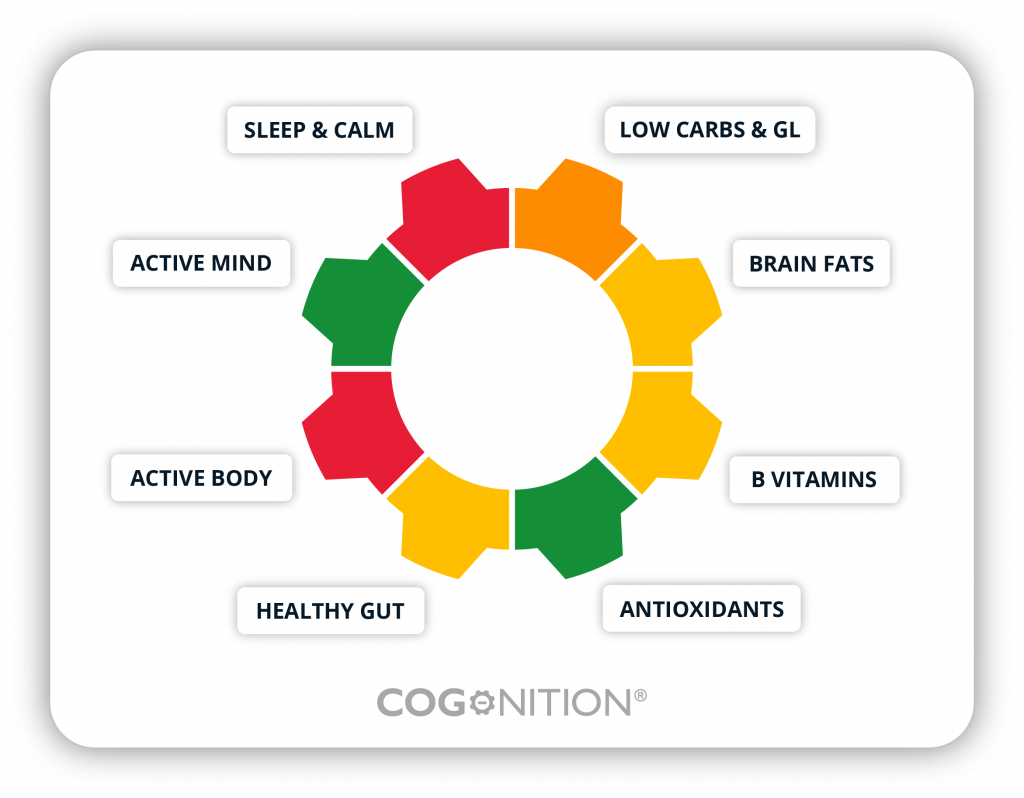
Your risk is divided into eight wellness domains (see image), highlighting areas to focus on to enable brain and cognitive powers to stay intact.
Here are 25 simple steps you can take to dementia-proof your diet and lifestyle taken from our advice and my recent book, Upgrade Your Brain, which gives more detail for those who want to dig deeper.
Brain Fats – Up your brain fats – omega-3, phospholipids and vitamin D
1. Get your omega-3 index above 8%
You can measure your omega-3 index with a home test kit. Psychologists at the Linda Loma University in California did this for a group of older people, publishing their results in the journal Brain Sciences (1). They found that the higher a person’s omega-3 index was, the more white matter there was in their brain and the better they performed in cognitive tests.
You can test your levels with a simple Omega-3 Index test or as part of the DRIFT 5-in-1 test.
2. Eat oily fish three times a week or SMASH it
S for salmon, M for mackerel, A for anchovies, S for sardines, and H for herrings or kippers. Caviar has the highest known levels of omega-3 DHA, which builds your brain. Even having one serving a week almost halves the risk of Alzheimer’s. (2, 3). See the Best Fish for Brain table for a comparison of omega-3 levels, mercury content, and sustainability.
3. Supplement omega-3 fish oils
Aim for any supplement that provides 500mg of omega-3 DHA. This may mean two capsules a day. See this recent study in the American Journal of Clinical Nutrition of over 100,000 people (4). If you’re vegan, supplement with algal omega-3 DHA.
Read more about omega-3 supplementation here.
4. Eat an egg and/or nuts and seeds every day
Eating two eggs a week halves future risk of Alzheimer’s (5). The best seeds are chia, flax, hemp and pumpkin. The best nuts are walnuts, pecans, and macadamia, but all nuts are a good source of protein and minerals.
5. Exercise outdoors and supplement vitamin D
Low blood levels of vitamin D make cognitive decline 19 times more likely. If your vitamin D level is high, Alzheimer’s disease is 4 times less likely. People who take vitamin D, which is especially important in winter, have a one-third lower risk. You can test your levels with a simple vitamin D test or as part of the DRIft 5-in-1 test.
Low Carb and GL – Eat a low-carb, low sugar, low GL diet
6. Avoid sugar and don’t eat junk food
Avoid the white stuff – flour, sugar, rice and especially ultra-processed foods. Fructose and high fructose corn syrup are common sweeteners. They are especially harmful to the brain. Read more about how sugar affects brain health in Is Sugar Killing Your Brain?.
7. Eat your fruit, don’t drink it
Stay away from fruit juices as they contain no fibre but lots of sugar. A glass of orange juice is worth three oranges’ worth of juice, but no fibre. Fibre fills you up. Learn more about the effects of fructose on health and the brain in this article on fructose.
8. Limit your intake of bread, pasta, and potatoes
If you eat more than 100 to 150 g a day of grains or potatoes, which is one or two servings max, your risk of dementia goes up .
9. Limit alcohol to a glass of wine a day or equivalent
Drinking alcohol, particularly red wine, can lower risk if done in moderation. However, the benefits are limited. . Abstinence increases risk, as does having more than 14 units of alcohol a week, according to a study in the British Medical Journal (6). Read more in The Truth About Alcohol and Your Brain
10. Add C8 oil to your coffee
The brain can run on either glucose or ketones, made in the liver from a ‘medium chain triglyceride’ called C8 oil. Two tablespoons of a C8-rich oil improve cognitive abilities and help provide the brain with energy (7). Read more about MCT oil here.
B vitamins – Keep your homocysteine low with B vitamins
11. Test your blood homocysteine level with a home test kit and supplement B vitamins if needed
A homocysteine level above 10 mmol/l, which is extremely common in people over 60, is strongly associated with accelerated brain shrinkage and increases risk of Alzheimer’s ten-fold. You can test your levels with at-home homocysteine test or as part of the DRIFT 5-in-1 test. Homocysteine is easily lowered by supplementing vitamin B6, B12 and folate but the amounts needed are much higher if your homocysteine level is high. Read more about lowering your homocysteine here.
12. Eat a serving a day of both greens and either beans, lentils, nuts or seeds
These are all high in the B vitamin folate as well as vitamin B6. A study in Holland gave 818 people aged 50 to 70 a folic acid supplement of 800mcg for three years, versus a placebo. At the end of the study, compared to those taking the placebo, those taking folic acid were functioning at the equivalent of being 5.5 years younger (8).
Antioxidants – Eat and drink anti-ageing antioxidants and polyphenols [4]
13. Eat lots of fresh fruit and veg
The more you eat, the better, though the benefits start to plateau at 500g a day, which is about five to six servings. People who ate the most greens had much less Alzheimer’s-related issues than those who ate the least.(9) . Berries are particularly protective, especially blueberries and strawberries. Read more about foods that help protect brain health in How to Keep Your Brain Young.
14. Drink Teash fruit and veg
The more you drink, the better as confirmed by a recent study from Singapore (8). However, other studies are conflicting (9). My view is to drink tea, green over black, in preference to coffee, and limit your intake to one or two cups a day.
15. Eat dark (70%+) chocolate
The benefit peaks at 10g, or about 3 pieces. More recent studies on cocoa, a rich source of flavanols, have shown improved cognition, possibly by improving circulation (11).
16. Supplement vitamins C and E – and don’t smoke!
A study of 4,740 elderly people in Utah found that those taking both vitamin E and C reduced their risk of developing Alzheimer’s by 23%.
Taking either cut risk by a quarter (12). Overall, a meta-analysis of vitamin C studies concludes thta supplementation lowers risk by about 26% (12). Smokers need at least twice as much vitamin C as non-smokers, just to have basic vitamin C levels in their blood. Smoking also raises homocysteine levels, another risk factor.
Healthy Gut – A healthy gut is a healthy brain [5]
17. Eat plenty of soluble fibre and prebiotic foods
Fibre from foods like oats, chia, and flax seeds benefits our gut microbiome. Prebiotic foods like garlic, artichoke, leeks, and onions nourish and support healthy gut bacteria.
When you eat potatoes or rice, cook them ahead of time. Then, store them in the fridge. Reheating food increases the amount of prebiotics, also known as resistant starch.
Supplementing vitamin C helps promote lactobacillus and bifidobacteria.
Active Body – Exercise and keep physically active [6]
18. Get active for 20 minutes … and build and maintain muscle
Spend at least 20 minutes doing activities such as walking, gardening, housework or repairing things – anything that gets you moving. Don’t limit yourself to ‘exercise’– anything that gives you a faster heart rate and engages different sets of muscles is good. Muscle mass best predicts both your brain volume and risk of cognitive decline in later years (13).
19. Get balancing!
The brain works hard in exercise, especially if it involves complex movements and learning, such as learning to dance, or doing different movements in a yoga or t’ai chi class or running or walking on uneven surfaces. The brain is processing a lot of information, triggering patterns of muscle movement and keeping you in balance.
Active Mind – Keep yourself socially and intellectually active [7]
20. Read, watch, or listen to stimulating content
A simple yardstick is to ask, ‘Am I learning anything? Am I using my mind?’ Reading books or listening to podcasts can be great ways to stimulate your mind, depending entirely on what you engage with.
21. Be social
Aim to spend at least two hours a week with other people in a social (not work) setting – groups, friends, family, etc.
22. Challenge your brain daily
Try challenging your brain with puzzles and word games such as Sudoku, crosswords or Wordle. You might also enjoy using a brain-training app. Two popular options with strong user ratings and research backing are BrainHQ and Lumosity, both designed to support memory, attention and processing speed.
23. Learn something new and challenging
Learning a new language, sport or musical instrument are all good – anything that you keep practising. This fascinating study looked at the brains of musicians and showed that amateur musicians benefited most (14).
Sleep and Calm – Sleep well, stay calm and live purposefully
24. Avoid alcohol before bed and limit any caffeine intake after midday
Caffeine suppresses melatonin, which helps you sleep, for up to 10 hours.
25. Aim to follow a soothing bedtime routine
Ensure your bedroom is quiet and dark and you are comfortable. Turn off mobile phones and Wi-Fi connections at night. Prioritise relaxing activities in the few hours before you go to bed.
Read more about the powerful connection between sleep, stress and brain health in Sleep, Stress and the Brain, including why quality sleep is essential for memory, emotional resilience and long-term cognitive function.
So, while you do not need to implement all 25 things this week, think about what 2-3 things you could focus on this month.
For further support, monthly coaching and detailed personalised email guidance make sure you join us as a FRIEND so you get access to  – your 6 month programme to help you upgrade your brain and improve your cognitive function. All for just £5 a month or £50 a year!
Food for the Brain is a not-for-profit educational and research charity that offers a free Cognitive Function Test and assesses your Dementia Risk Index to be able to advise you on how to dementia-proof your diet and lifestyle.
By completing the Cognitive Function Test you are joining our grassroots research initiative to find out what really works for preventing cognitive decline. We share our ongoing research results with you to help you make brain-friendly choices.
Please support our research by becoming a Friend of Food for the Brain.
.
References
4 Gong, Q., Xie, L., Bi, M., & Yu, L. (2021). A probability formula derived from serum indicators, age, and comorbidities as an early predictor of dementia in elderly Chinese people. Brain and Behavior 11, e2236. https://doi.org/10.1002/brb3.2236
7 Croteau E, Castellano CA, Richard MA, Fortier M, Nugent S, Lepage M, Duchesne S, Whittingstall K, Turcotte ÉE, Bocti C, Fülöp T, Cunnane SC. Ketogenic Medium Chain Triglycerides Increase Brain Energy Metabolism in Alzheimer’s Disease. J Alzheimers Dis. 2018;64(2):551-561. doi: 10.3233/JAD-180202. PMID: 29914035.
9 Devore E et al, ‘Dietary intakes of berries and flavonoids in relation to cognitive decline’, Annals of neurology 2012; 72: 135-43; see also Agarwal P, Holland TM, Wang Y, Bennett DA, Morris MC. Association of Strawberries and Anthocyanidin Intake with Alzheimer’s Dementia Risk. Nutrients. 2019 Dec 14;11(12):3060. doi: 10.3390/nu11123060. PMID: 31847371; PMCID: PMC6950087.
12 Basambombo LL, Carmichael PH, Côté S, Laurin D. Use of Vitamin E and C Supplements for the Prevention of Cognitive Decline. Ann Pharmacother. 2017 Feb;51(2):118-124. doi: 10.1177/1060028016673072. Epub 2016 Oct 5. PMID: 2770818; see also Yu JT, Xu W, Tan CC, Andrieu S, Suckling J, Evangelou E, Pan A, Zhang C, Jia J, Feng L, Kua EH, Wang YJ, Wang HF, Tan MS, Li JQ, Hou XH, Wan Y, Tan L, Mok V, Tan L, Dong Q, Touchon J, Gauthier S, Aisen PS, Vellas B. Evidence-based prevention of Alzheimer’s disease: systematic review and meta-analysis of 243 observational prospective studies and 153 randomised controlled trials. J Neurol Neurosurg Psychiatry. 2020;91(11):1201-9. Epub 2020/07/22. doi: 10.1136/jnnp-
13 Wang W, Luo Y, Zhuang Z, Song Z, Huang N, Li Y, Dong X, Xiao W, Zhao Y, Huang T. Total and regional fat-to-muscle mass ratio and risks of incident all-cause dementia, Alzheimer’s disease, and vascular dementia. J Cachexia Sarcopenia Muscle. 2022 Oct;13(5):2447-2455. doi: 10.1002/jcsm.13054. Epub 2022 Jul 20. PMID: 35856185; PMCID: PMC9530585.
Further info