

Dopamine and the Brain: Is Modern Life Hijacking Your Reward System?
By Patrick Holford. In this article, we explore the important relationship between dopamine and the brain.
We already know that today’s diet is low in brain-friendly fats and nutrients and high in sugar and ultra-processed food. It’s likely shrinking our brains, dumbing us down, and driving the rise in mental health problems. But diet isn’t the only thing engineering our mental decline. Tech, sugar, caffeine and alcohol are all pulling the same lever in your brain: dopamine.
Dopamine makes us want the reward. It isn’t what makes us enjoy it. It drives the urge to check, eat, drink or scroll again. That distinction matters, because marketers behind our food, phones and drinks have got very good at triggering the itch without ever satisfying it. That’s why you can eat a whole packet of biscuits, or scroll for an hour, and still feel restless afterwards.
The mechanism: variable reward
This was first identified in the 1930s by psychologist B.F. Skinner. He found that mice responded most frequently to a reward-associated lever when rewards arrived unpredictably. The mouse never knew which press would pay off. We’re wired the same way: if a reward feels random, and checking for it costs us nothing, we end up checking compulsively. It’s the exact mechanism behind a fruit machine, and it’s the exact mechanism behind your phone’s notification badge.
This manipulation of the brain’s stress-and-reward response is one of its oldest systems: essential for survival, but also what makes us impulsive, manipulable, and, frankly, easier to sell to. Multinational companies have learned to get us neurochemically hooked on their products. They use the language of happiness to sell us pleasure: the happy hour, the happy meal, happiness in a can. But joy and contentment are governed by serotonin, not sugar or a special offer, and chasing dopamine too hard actively undermines it. This relationship between dopamine and the brain helps explain why repeated rewards can become so difficult to resist.
Dopamine, pleasure and the brain hijack
“The more pleasure you seek, the more unhappy you get,” says Professor Robert Lustig, author of The Hacking of the American Mind. Too much dopamine suppresses serotonin, leaving you feeling flat, restless or low once the initial hit fades. He describes this constant cycle of stimulation and reward-seeking as a kind of “brain hijack”, and one possible piece of a much bigger mental health picture. And that picture is concerning: in England, 92.6 million antidepressant items were dispensed in 2024/25 alone, up almost 4% on the year before,[1] while in the US, 19.3% of adults reported taking prescription medication for their mental health in 2024.[2]
“We are the most in debt, the most obese, the most medicated and the most drugged-up adult population in human history,” Lustig argues. We’ve learned to fool our own brains. In doing so, we’ve fooled ourselves by engineering addictive foods and behaviours around us.
Sugar, dopamine and the brain: not so different from cocaine
Sugar stimulates dopamine and endorphins in much the same way as cocaine and heroin. It triggers the reward system and, with overuse, can lead to reward deficiency, where you need more to feel the same lift.[3] Dr Candace Pert, the neuroscientist who discovered the opiate receptor, was among the first to say this outright: “I consider sugar to be a drug, a highly purified plant product that can become addictive. Relying on an artificial form of glucose, sugar, to give us a quick pick-me-up is analogous to, if not as dangerous as, shooting heroin.”[4] That was heresy when she said it. It’s now closer to conventional wisdom, but it’s still not sugar acting alone.
Why sugar and fat are a powerful combination
Neuropharmacologist Professor Paul Kenny discovered the real driver almost by accident, feeding rats different diets in his Mount Sinai lab. Rats fed only sugary food, or only fatty food, barely gained weight: they self-regulated. But rats fed a 50/50 combination of sugar and fat, the cheesecake diet, “dive head first into a slice and gorge so vigorously that it covered its fur in blobs.” They kept eating as if the “I’m full” switch had stopped working, stopped exercising, and gained significant weight within a week.[5] When Kenny then offered them an electric shock as a warning before the food arrived, rats on a normal diet fled. The cheesecake rats ignored the shock and kept eating anyway; their reward-seeking had overridden their own self-preservation.
Dopamine resistance and food addiction
This is the pattern behind food addiction more broadly. In some people, the reward system becomes so overstimulated that it overpowers the normal “stop eating” signal. As with alcohol and drugs, the more you have, the more you need, and dopamine receptors gradually shut down in response, a cycle researchers call dopamine resistance. People with fewer dopamine D2 receptors are, in fact, at greater genetic risk of both obesity and addiction. So if this feels like an uphill battle for you specifically, that’s not just willpower.[6,7] Counter-intuitively, some studies suggest people people with a higher weight respond less strongly to food reward, not more. This means they may need to eat more just to feel the same lift a leaner person gets from less.
No single ingredient drives this as reliably as the fat-and-sugar combination together, at high calorie density.[8,9] Think biscuits, doughnuts, chocolate, ice cream, cakes and many fast ultra processed foods. Nature simply doesn’t produce foods like this; only manufacturing does.
Sugary drinks exploit the reward system in a slightly different way. The same logic explains a can of cola. Caffeine, sugar and salt combined to make you drink more, with fructose (rather than glucose) doing extra work, because your body is slower to register “enough” from fructose, so you keep consuming past the point you’d normally stop. That’s also why fructose, often as high-fructose corn syrup, has quietly become the default sweetener in ultra-processed food.
Are you addicted to your smartphone? Dopamine and the brain in the digital age
Of everything that’s changed this century, the digital revolution has reshaped daily life most completely. It has changed not just what we do, but the sheer pace we live at. People everywhere are sleeping less, resting less, and burning out faster, and it shows up in rising work absence, anxiety and depression, especially in cities.
Phone-checking estimates vary enormously depending on who’s asking and how. A 2026 US survey put the average at 186 checks a day, down from 205 the year before, roughly once every five minutes of waking time.[10] A separate, larger commercial survey in 2022 put the figure far higher, at 352 checks a day, up from just 96 in the same survey’s 2019 run.[11] The truth is that “checks per day” is measured differently by almost everyone who studies it, so treat any single number as an illustration of scale rather than a precise fact; the honest takeaway is that the frequency has clearly risen, by a lot, in a few years.
How smartphones keep us checking
Whatever the exact count, the direction is the same. Our phones have become almost constant companions, including at moments we’d probably rather they weren’t. A 2026 study published in JAMA Pediatrics found that over 70% of parents and nearly 70% of children used a phone or other digital device during their family’s most recent meal together.[12] What’s better established: separate UK research from January 2025 found 81% of Britons reach for their phone as one of the first things they do after waking,[13] and a May 2025 US survey found 43% of adults use their phone within ten minutes of trying to fall asleep, and 44% within ten minutes of waking, rising to around 60% among under-30s.[14]
Social media, dopamine and the brain reward loop
Why does it work so well? To sell things. “I feel tremendous guilt,” Chamath Palihapitiya, Facebook’s former Vice President of User Growth, told an audience of Stanford students. “The short-term, dopamine-driven feedback loops that we have created are destroying how society works.” Every major platform is built the same way. It captures your attention, then serves ads tailored to what it has learned about you. A red notification badge, a “like” or an unexplained ping can provide a small hit of validation. Facebook has even been documented timing notifications for when a user is likely to be feeling insecure or bored, when that validation may land hardest.
There’s a genuinely useful finding buried in the research here. A study of 143 University of Pennsylvania undergraduates found that limiting social media use to 30 minutes a day significantly reduced loneliness and depression.[15] The researchers’ own conclusion was blunt: “limiting social media use to approximately 30 minutes per day may lead to significant improvement in well-being.” That’s not a difficult habit to test on yourself for two weeks.
Whether it’s a text, a “like” or a notification, the mechanism is identical to sugar: a dopamine hit, scheduled by an algorithm built to know exactly when a variable reward will keep you coming back. This constant cycle of dopamine and reward can train the brain to seek stimulation more frequently, making it harder to switch off.
Your brain’s reward system, in one paragraph : dopamine and the brain
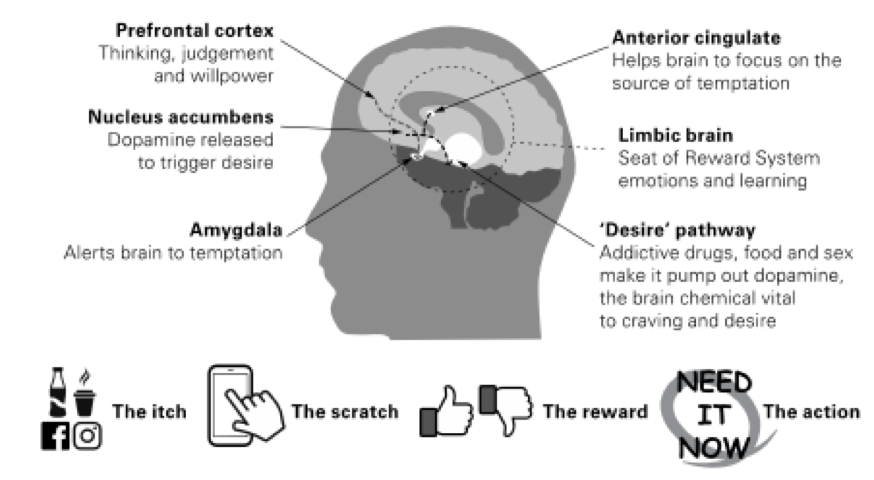
All of this (sugar, phones, gambling, gaming, alcohol) routes through the same small structure: the nucleus accumbens, the brain’s dopamine-based reward hub. The more dopamine you release chasing something, the more your receptors down-regulate in response, so you need progressively more stimulation to feel the same lift. That’s the hijack. It’s not a character flaw; it’s the same ancient survival circuit being pulled by people who’ve studied exactly how to pull it. Understanding dopamine and the brain helps explain why these everyday rewards can become so compelling.
Alcohol, dopamine and the brain: reward disguised as relaxation
Alcohol might seem different from sugar, ultra-processed food or social media, but it taps into the same reward circuitry. The difference is that while we often reach for sugar, caffeine or our phones for stimulation, alcohol is frequently used for the opposite reason: to switch off, unwind or take the edge off stress. Yet it still acts on the brain’s reward system, which is part of what can make that evening drink so easy to repeat. Over time, tolerance can creep up: a glass a night becomes two, then half a bottle, then more.
Alcohol is a well-established neurotoxin,[16] and perhaps the most normalised drug of the lot. Smoking has become socially unacceptable in a single generation; drinking, outside of visibly heavy use, largely hasn’t. Yet alcohol remains a major cause of premature death and disability. The World Health Organization estimates that it was responsible for 2.6 million deaths worldwide in 2019, with 13% of deaths among 20 to 39-year-olds attributable to alcohol.[17] In the UK, 9,809 alcohol-specific deaths were registered in 2024, still substantially above pre-pandemic levels.[18] Despite this scale of harm, alcohol remains deeply embedded in how we socialise, celebrate and switch off. It is another example of how dopamine and the brain can shape repeated reward-seeking behaviour.
How much alcohol is too much?
What’s less well known is that the health risk from alcohol isn’t confined to heavy drinkers. It rises with the amount consumed, even at moderate levels. The encouraging flip side is that reducing consumption reduces risk. To make that concrete, a 12.5%-ABV bottle of wine contains about 75g of alcohol. Two large glasses, roughly two-thirds of a bottle, contain about 50g, while one medium 175ml glass contains about 17.5g.
More recent research adds to the case for keeping alcohol intake low. A 2022 study of 36,678 UK Biobank participants found that consuming more than one unit of alcohol per day was associated with progressively lower grey and white matter volume in the brain.[25] Neuropsychopharmacologist Professor David Nutt has advocated lower-risk daily alcohol limits. He recommends around 15g for women and 20g for men, with alcohol-free days each week. The current UK Chief Medical Officers’ guideline remains no more than 14 units a week for both men and women. That’s about 112g of pure alcohol, spread over three or more days rather than concentrated into one or two sessions.[19] Nutt was dismissed as chair of the government’s Advisory Council on the Misuse of Drugs in 2009. He had repeatedly challenged drug harm classifications, arguing that alcohol and tobacco were more harmful than several illegal drugs, including ecstasy.[20]
Are you addicted to stimulants?
The other major, socially glorified drug is caffeine, mostly as coffee, though strong tea carries a similar caffeine load to a regular cup of coffee. Like sugar, alcohol and your phone, it stimulates dopamine release and a genuine hit of reward. This connection between dopamine and the brain is part of what makes caffeine so effective at reinforcing the habit of reaching for another cup. Picture a day with no coffee, tea, chocolate or that end-of-day drink. If your instinctive reaction is “absolutely not,” there’s a real chance you have some level of dependence, anywhere from mild and manageable to something quietly running your day.
Whatever the level, the net effect of stimulant dependence is always less energy, not more. One of my clients, Bobbie, is a good example. She already ate well and took a sensible, targeted supplement programme. Her only real complaints were low morning energy and occasional headaches, and her only vice was three cups of coffee a day. She agreed, reluctantly, to drop the coffee for a month. Her energy came back, and the headaches stopped.
Stimulant Inventory
A simple 3‑day self-audit of caffeine, sugar, alcohol and nicotine
It’s worth auditing your own stimulant intake occasionally, honestly, not the version you’d tell your doctor. Use the table below to tick off each item as you have it, for three ordinary days. You’re not aiming for a perfect score; you’re just collecting honest, useful data on what you’re actually reaching for, and how often.
Print it and keep it by the kettle, or fill it in on screen as you go.
| Item | A unit equals |
|---|
This tracker is for personal reflection only. It isn’t a diagnostic tool, and it doesn’t replace advice from your GP or a qualified practitioner. If you’re concerned about your drinking, smoking, or caffeine or sugar intake, please speak to one.
Like Bobbie, it’s worth auditing your own stimulant intake occasionally, honestly, not the version you’d tell your doctor. Try asking yourself:
- Do you ever buy sweets and hide the wrappers so no one else knows you’ve eaten them?
- Do you swoon at the dessert menu before you’ve even ordered a main course?
- How much do you think about, or look forward to, your morning coffee, or the second cup?
- How important is the after-work drink, really?
- Does everyone around you actually know how much you smoke?
- Has your “normal” coffee crept up to a double-espresso equivalent, more coffee at home than you used to make?
- Do you still get a noticeable “kick” from caffeine, or does it now just relieve the fuzzy tiredness of not having had it yet?
None of these are shameful on their own; they’re just useful, honest data. What they point to, taken together, is a chemical dependency that quietly drains your energy and mood, and at its more extreme end, feeds into genuine mental health problems.
Caffeine, withdrawal and sleep
If you wake up feeling fine and function well without coffee, that’s a good sign. If you also sleep normally, one daily coffee isn’t necessarily a problem worth solving. The real test of your relationship with caffeine is what happens when you stop. No effect suggests little or no physical dependence, while headaches, fatigue and irritability are well-established signs of caffeine withdrawal.[21] Withdrawal can begin within 12 to 24 hours and typically peaks within one to two days. It usually resolves within several days. For some people, just 100mg of caffeine a day, roughly one cup of coffee, can cause withdrawal symptoms when stopped abruptly.[22]
It’s also worth knowing that caffeine can interfere with sleep even when consumed several hours before bed. One controlled study found that a 400mg dose taken six hours before bedtime significantly reduced sleep. The effect of a normal-strength cup of coffee is likely to be smaller.[23] If sleep is already a struggle, a simple experiment is to set a caffeine cut-off around noon and see whether sleep improves.
Tea or coffee?
Both raise adrenaline, cortisol and dopamine while blocking adenosine, the brain’s natural calming chemical. That adrenaline spike gives you a lift now, but often leaves you flatter and more fatigued later, and if you respond by having more caffeine, you end up agitated by day and wired-but-tired by night. It’s another important connection between dopamine and the brain when looking at everyday stimulant use.
Tea contains caffeine, but also theanine, a calming amino acid. Theanine has been shown to support cognitive performance [24] and protect GABA receptors, effectively the brain’s adrenaline off-switch. On balance, tea comes out ahead of coffee. Green tea edges out black tea because it retains more antioxidants and polyphenols.
Benefits, or just good excuses?
There’s no shortage of research on the upsides of tea, coffee and even moderate alcohol, from resveratrol in red wine to polyphenols in coffee and cacao and antioxidants in tea.
But almost any dependency generates its own psychological alibi: “it’s just a nice sauce” (sugar), “a little of what you fancy never hurt anyone,” “I’m too stressed not to have a drink,” “I need a coffee to focus.” These substances work. That’s precisely why we reach for them. Used with real intention, in the right moment, that’s not automatically a problem. A sugary drink after a genuine shock, or caffeine to get through a late deadline, are reasonable uses of a tool.
The problem comes when these habits start to stack up. Sugar, caffeine, alcohol, tech and social media can combine into a system that leaves you more tired, anxious and low than if you’d never reached for any of them.
The good news is that this is genuinely reversible. It doesn’t require an overhaul, just a few deliberate changes to how you use each of these levers.
Simple ways to win back your brain
-
Cap social media at 30 minutes a day. Build down to it if you need to. Put your phone on airplane mode at least an hour before bed and for the first hour after waking. If it has to be on, hold off on social apps for the first couple of hours of the day.
-
Limit caffeine to roughly 100mg a day. That’s about one strong coffee or two weaker cups of tea. For a second cup, reuse the same tea bag or pull a weaker filter coffee. Cut off all caffeine after noon.
-
Avoid foods with added sugar. Check labels, since it’s often hiding as high-fructose corn syrup, dates or raisins. As a rule of thumb, 5g per 100g is roughly a teaspoon-equivalent; anything above 22.5g per 100g counts as high-sugar, and 5g or below as low-sugar. Get your sugar from whole fruit where possible, and treat fruit juice as a sugar drink, not a health drink.
-
Cap alcohol at 20g a day. That’s a maximum of around two small (125ml) glasses of wine, with at least two alcohol-free days a week.
Want to understand whether food or drink has hijacked your own reward system, and what you can do about it? Watch our webinar with psychologist Dr Jen Unwin to discover how to recognise and break the cycle of food and drink addiction. You can also become a FRIEND and get support to build healthier habits that help protect your brain for the long term.
None of this replaces individual medical advice. If drinking, medication, sleep or your mood feel genuinely out of your control, talk to your GP or a qualified practitioner alongside making these changes.
References
- NHS Business Services Authority, Medicines Used in Mental Health, England, 2015/16 to 2024/25 (92.6 million antidepressant items dispensed in 2024/25, a 3.94% increase on 2023/24).
- CDC/NCHS data reported via OPEN MINDS, “19.3% of U.S. Adults Used Prescription Mental Health Medication in 2024.”
- P. Holford, How to Quit Without Feeling S**t, Piatkus, 2008.
- P. Holford, How to Quit Without Feeling S**t, Piatkus, 2008.
- Johnson, P.M. & Kenny, P.J., “Dopamine D2 receptors in addiction-like reward dysfunction and compulsive eating in obese rats,” Nature Neuroscience (2010), 13(5), 635-641.
- Kenny, P.J., “Reward Mechanisms in Obesity: New Insights and Future Directions,” Neuron, 24 Feb 2011, 69(4), 664-679.
- See reference 6.
- Avena, N.M. & Gold, M.S., “Food Addiction, Sugars, Fats and Hedonic Eating,” Addiction (2011), 106(7), 1214-1215.
- Lennerz, B. et al., “Effects of dietary glycemic index on brain regions related to reward and craving in men,” American Journal of Clinical Nutrition, 98(3), 641-647, Sept 2013.
- Reviews.org, Cell Phone Usage Stats 2026, based on a Q4 2025 survey of US adults (186 checks/day, down from 205 the prior year).
- Asurion, 2022 consumer research (nearly 2,000 US adults), reported via TechSpot, “Adults in the U.S. check their phones 352 times a day on average, 4x more often than in 2019.” (commercial survey research, not peer-reviewed; included to show the range of published estimates)
- Study reported in JAMA Pediatrics (2026), covered via news report: over 70% of parents and nearly 70% of children used a phone/digital device during their family’s last meal together. [VERIFY/UPDATE: this is a secondary news report of the JAMA Pediatrics study; locate and cite the original journal article directly before publishing.]
- Research reported by Advanced Television, “Research: 81% Brits reach for phone after waking,” 9 January 2025. [VERIFY/UPDATE: confirm the original research body/survey behind this news report before publishing.]
- YouGov, phone use survey, 23-25 May 2025 (n=1,129 US adults): 43% use their phone within 10 minutes of falling asleep; 44% within 10 minutes of waking; both figures around 60% among under-30s.
- University of Pennsylvania study, Journal of Social and Clinical Psychology (2018), 37(10), 751.
- Nutt, D. et al., “Alcohol and the Brain,” Nutrients (2021), 13, 3938.
- Office for National Statistics, Alcohol-specific deaths in the UK (latest edition).
- UK Government, Clinical guidelines for alcohol treatment (Chief Medical Officers’ low-risk drinking guideline).
- The Guardian, “Drugs adviser David Nutt sacked by government,” 30 October 2009.
- Juliano, L.M. & Griffiths, R.R., “A critical review of caffeine withdrawal,” Psychopharmacology (2004), 176(1), 1-29.
- Drake, C. et al., “Caffeine effects on sleep taken 0, 3, or 6 hours before going to bed,” Journal of Clinical Sleep Medicine (2013), 9(11), 1195-1200.
- Anas Sohail, A. et al., “The Cognitive-Enhancing Outcomes of Caffeine and L-theanine: A Systematic Review,” Cureus (2021), 13(12), e20828.
- Daviet R, Aydogan G, Jagannathan K, Spilka N, Koellinger PD, Kranzler HR, et al. Associations between alcohol consumption and gray and white matter volumes in the UK Biobank. Nat Commun. 2022;13(1):1175. doi:10.1038/s41467-022-28735-5.
——–
Food for the Brain is a non-for-profit educational and research charity that offers a free Cognitive Function Test and assesses your Dementia Risk Index to be able to advise you on how to dementia-proof your diet and lifestyle.
By completing the Cognitive Function Test you are joining our grassroots research initiative to find out what really works for preventing cognitive decline. We share our ongoing research results with you to help you make brain-friendly choices.
Please support our research by becoming a FRIEND of Food for the Brain.